

Skip to content
Auriga accounting
Edit Content
auriga accounting
AURIGA ACCOUNTING PRIVATE LIMITED Untitled 1200 x 630 px 84

This guide explains what happens when a company’s bank account is frozen after the company is struck off, most commonly due to failure to file financial statements with the Ministry of Corporate Affairs (MCA). It outlines a step-by-step procedure to unfreeze the bank account in accordance with the provisions of the Companies Act, 2013.

Banks regularly verify the status of corporate customers through the MCA database. If a company is shown as “struck off,” the bank freezes all associated accounts, stopping both debit and credit transactions and severely disrupting business operations. In such cases, the company is also unable to open new bank accounts or operate existing ones.

To check whether a company has been struck off, visit the MCA’s official website and review the company status under the “Master Data” section. To avoid strike-off, it is essential to file financial statements and statutory returns on time. Auriga Accounting pvt. ltd. experts can help ensure compliance and assist with account unfreezing when required.

Financial Statements

Financial statements are formal records that present a comprehensive view of a company’s financial position and performance for a specific period. These statements are prepared in accordance with applicable accounting standards and statutory requirements. The key components of financial statements include:

  • Balance Sheet

  • Income Statement (Profit and Loss Account)

  • Cash Flow Statement

  • Statement of Changes in Equity

  • Notes to the Financial Statements

Under the Companies Act, 2013, every registered company is required to file a copy of its financial statements with the Registrar of Companies (ROC) using Form AOC-4.

The financial statements must be filed within 30 days of the Annual General Meeting (AGM). The AGM is generally required to be held within six months from the end of the financial year.

Form AOC-4 must be accompanied by all relevant documents, including the balance sheet, profit and loss account, cash flow statement, auditor’s report, and director’s report. Where applicable, consolidated financial statements must also be prepared and filed along with standalone financial statements.

Penalties for Non-Compliance

Failure to file Form AOC-4 as required under Section 137 of the Companies Act, 2013 can lead to serious consequences. Penalties may be imposed on the company, its directors, and officers in default. The amount of penalty depends on the duration of non-compliance and can become substantial if delays persist.

Consequences of Non-Compliance with AOC-4

1. Company Strike-Off

The ROC has the authority to initiate strike-off proceedings against companies that fail to meet statutory filing obligations, including the filing of financial statements. Persistent non-compliance may result in notices and warnings, followed by removal of the company’s name from the register.

2. Freezing of Bank Accounts

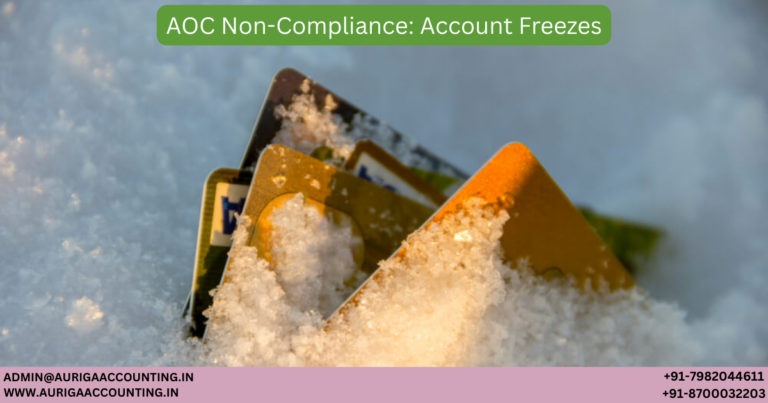
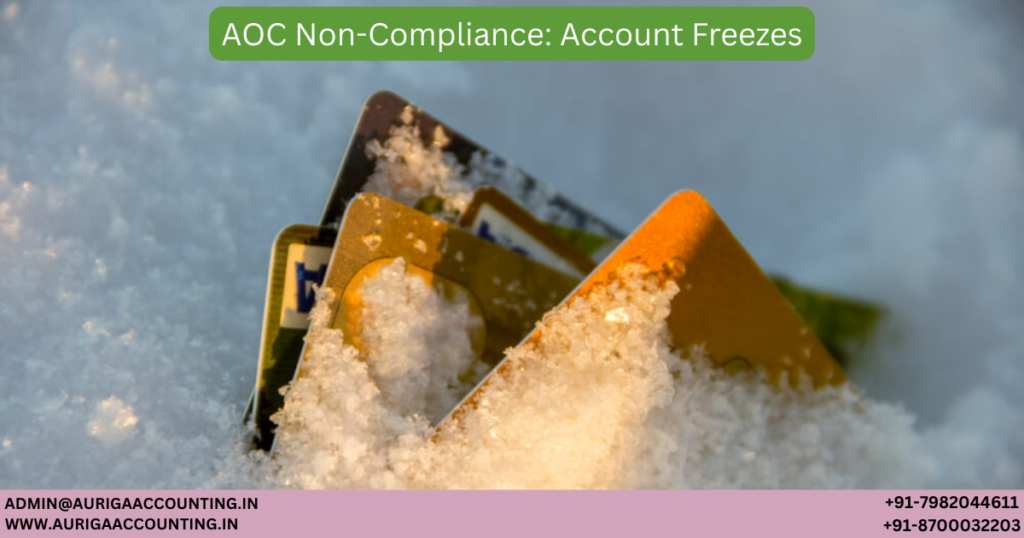
When a company fails to file its financial statements and is struck off, its bank accounts are typically frozen. This action is supported by Section 248 of the Companies Act, 2013, and is intended to protect creditors and stakeholders by preventing misuse of funds.

A company may be struck off if it has not commenced business within one year of incorporation or has remained inactive for two consecutive financial years. Non-filing of statutory documents is treated as evidence of inactivity and lack of compliance.

Once marked as “struck off” on the MCA portal, the company is barred from filing any ROC forms, except those related to orders of the National Company Law Tribunal (NCLT).

To unfreeze bank accounts and restore the company’s legal status, directors must approach the NCLT under Section 252 of the Companies Act, 2013.

Company Restoration Process: Steps to Reinstate a Struck-Off Company

Step 1: Audit of Accounts

The company must first conduct an audit of its accounts and prepare its financial statements. If the audit is ongoing, a compounding application may also be required in accordance with applicable legal provisions.

Step 2: Filing a Petition with the NCLT

A petition for restoration must be filed with the NCLT by one or more shareholders. The application must be submitted along with prescribed fees and supporting documents, including:

  • Certified copies of MOA and AOA

  • Certificate of Incorporation

  • List of directors

  • Certified true copy of master data

  • ROC strike-off order

  • Latest Income Tax Return

  • Signed balance sheets for the past three years

  • Certified true copy of bank statements

  • List of shareholders

  • Affidavit undertaking to file pending ROC forms within 30 days

  • Memorandum of appearance

  • Affidavit verifying the petition

  • Proof of payment of NCLT fees

These documents establish the company’s eligibility and intent for restoration.

Step 3: Justification for Restoration

The petition must clearly justify why the company should be restored. This may include evidence such as:

  • Records of recent purchases or sales

  • Filed Income Tax and GST returns

  • Active contracts or agreements

  • Issued cheques

  • Employee payroll records

If the company has not carried out recent business activities, it must explain the reasons and provide a clear outline of future business plans and proposed operations.

Step 4: Final Compliance Steps

After the NCLT issues the restoration order:

  • The company must file a certified copy of the order with the ROC in Form INC-28 within 30 days.

  • The ROC reinstates the company’s name in the register.

  • The company’s status on the MCA portal changes from “Struck Off” to “Active.”

  • Pending financial statements and annual returns can then be filed along with applicable late fees.

  • To unfreeze the bank account, the company must submit the NCLT order and updated MCA Master Data reflecting “Active” status to the bank.

Penalties and Fees for Restoration

Restoration involves payment of penalties and additional filing fees, which vary based on the period of default. Late filing fees for Form AOC-4 and Form MGT-7 / MGT-7A are levied at ₹100 per day, subject to statutory limits.

Since bank accounts remain frozen until restoration is completed, directors usually bear these costs personally. Delays significantly increase the financial burden, making prompt action essential.

Time Duration for Restoration

The restoration process typically takes around six months, depending on the availability of NCLT hearings. Generally, 3 to 4 hearings are required. The NCLT evaluates the company’s past operations, compliance status, and future viability before issuing a restoration order.

Donation as a Punitive Measure

In some cases, the NCLT may direct the company to make a donation to a government-designated relief fund, such as the Prime Minister’s Relief Fund, as a condition for restoration. These donations serve both as a punitive measure for non-compliance and as a contribution toward public welfare. The amount and recipient fund are specified in the NCLT order.

About the Author

Dakesh

Dakesh translates complex legal regulations into practical, easy-to-understand guidance, helping entrepreneurs stay compliant while building sustainable and scalable businesses.

RELATED ARTICLES

Untitled (1200 x 630 px) (84)
AOC Non-Compliance: Account Freezes
AOC Non-Compliance:...
Untitled (1200 x 630 px) (49)
MCA Updates Form CRL-1 to Enhance Subsidiary Disclosure Requirements
MCA Updates...
Untitled (1200 x 630 px) (54)
MCA Updates Equity Listing Rules: Form LEAP-1 Now Mandatory for Overseas Prospectus Filing
MCA Updates...
Untitled (1200 x 630 px) (52)
How to Save Tax on a Salary Above ₹10 Lakh
How to Save...
Untitled (1200 x 630 px) (50)
ROC Karnataka Penalty on Public Limited Company for AGM Notice Violation
ROC Karnataka...
Untitled (1200 x 630 px) (43)
Companies (Accounts) Rules, 2025 – Second Amendment
Companies...
Untitled (1200 x 630 px) (25)
MCA Rules for Company Name Approval
MCA Rules...
Director KYC How to File DIR-3 KYC
Director KYC: How to File DIR-3 KYC
Director KYC:...
LEAP-1 Form Purpose and Filing Procedure
LEAP-1 Form: Purpose and Filing Procedure
LEAP-1 Form:...
×