
Skip to content
Auriga accounting
Edit Content
auriga accounting
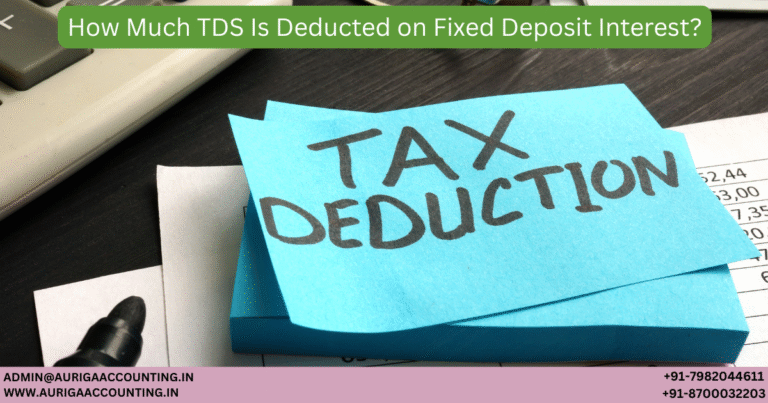
AURIGA ACCOUNTING PRIVATE LIMITED How Much TDS Is Deducted on Fixed Deposit Interest

“TDS on FD interest is charged at 10% when your total annual interest from fixed deposits exceeds ₹40,000 (₹50,000 for senior citizens). If you do not furnish your PAN to the bank, the TDS rate increases to 20%.”

Tax Deducted at Source (TDS) plays an important role in India’s tax framework by ensuring that tax is collected at the point of income generation instead of at the end of the financial year. It applies to several categories of payments, such as Fixed Deposit (FD) interest, salaries, commissions, rent, and professional fees. By deducting a portion of the payment before it is released, TDS helps maintain consistent tax collection and reduces the chances of tax evasion.

In this article, you will learn how TDS is applied to FD interest—covering current rates, exemption thresholds, and how the deduction is calculated. Simplify your TDS return filing with support from IndiaFilings experts!

What Is Tax Deducted at Source (TDS)?

Tax Deducted at Source (TDS) is a tax collection method in India in which a portion of certain payments—such as FD interest, salaries, commissions, rent, and professional fees—is deducted by the payer before the amount is credited to the recipient. The deducted tax is then deposited with the government on behalf of the payee.

This system ensures a regular inflow of tax revenue and helps curb tax evasion by bringing a wider range of transactions under the tax framework. The recipient can later claim credit for the TDS amount while filing their income tax return, thereby reducing their overall tax liability.

What Is TDS on Fixed Deposit (FD) Interest?

TDS on Fixed Deposit interest refers to the tax that banks or financial institutions deduct when crediting interest to a depositor’s account. As per the Income Tax Act, TDS must be applied at the prescribed rate if the total FD interest earned during a financial year crosses the specified threshold.

Individuals whose total income is below the taxable limit can avoid TDS by submitting the required declaration forms to the bank. Understanding TDS rules on FD interest is essential for accurate tax planning and compliance.

Current TDS Rates on FD Interest

The Income Tax Department prescribes fixed TDS rates on FD interest. The current applicable rates are:

CategoryTDS RateCondition
Resident Individuals & HUFs7.50%Annual FD interest exceeds ₹40,000
Senior Citizens7.50%Annual FD interest exceeds ₹50,000
FD Interest TDS Exemption Limit

The TDS exemption limit on FD interest is:

  • ₹40,000 for individuals

  • ₹50,000 for senior citizens

If your annual FD interest stays within these limits, the bank will not deduct TDS.

How Is TDS on Fixed Deposit Interest Calculated?

Interest earned on Fixed Deposits is fully taxable and is included under the head “Income from Other Sources.” It is taxed based on your applicable income tax slab. When the bank credits the interest, it automatically deducts the applicable TDS.

Below is an example illustrating the calculation:

Case 1:

Mr. Sharma invests ₹6,00,000 in a Fixed Deposit at 6% annual interest.

  • Annual interest earned: ₹36,000

  • Since this does not exceed the ₹40,000 exemption limit, no TDS is deducted.

Case 2:

Mr. Sharma invests ₹12,00,000 in an FD at 6% annual interest.

  • Annual interest earned: ₹72,000

  • As the interest exceeds the exemption limit, TDS is deducted at 10%.

  • TDS amount: ₹7,200 (10% of ₹72,000)

If Mr. Sharma has not submitted his PAN, TDS is deducted at a higher rate of 20%:

  • TDS amount without PAN: ₹14,400 (20% of ₹72,000)

You can use our FD Interest Calculator to estimate your interest earnings and TDS instantly.

What Are Form 15G and Form 15H?

Form 15G and Form 15H are self-declaration forms that individuals can submit to their bank or financial institution to request exemption from Tax Deducted at Source (TDS) when their total income is below the taxable limit. These forms help prevent unnecessary TDS deductions on interest income and make tax management easier. Below is a brief explanation of each form and how they differ.


Form 15G

Form 15G is a self-declaration form for individuals below 60 years of age who want to avoid TDS on their income. It is typically used when:

  • The individual’s total income is below the taxable threshold, and

  • Interest earned from Fixed Deposits, recurring deposits, or other income sources should not attract TDS.

By submitting Form 15G at the start of each financial year, eligible individuals can ensure that banks do not deduct TDS prematurely. This helps them manage their finances more efficiently and ensures taxes are paid only if their income crosses the exemption limit.


Form 15H

Form 15H is similar to Form 15G but is specifically designed for senior citizens aged 60 years or above. It allows them to request exemption from TDS when their total income is below the taxable limit.

Senior citizens often earn interest income from FDs, RDs, or other deposits, and submitting Form 15H ensures that TDS is not deducted unnecessarily. Like Form 15G, Form 15H must also be submitted at the beginning of each financial year to prevent TDS deductions.

Does the Bank Deduct TDS on FD Interest?

Yes, banks do deduct TDS on Fixed Deposit (FD) interest. As explained earlier, the TDS amount depends on your total annual interest income and whether you have provided your PAN to the bank.

Due Date for Depositing TDS

Once TDS is deducted, it must be deposited with the government within the prescribed timelines to avoid interest or penalties. The standard due dates are:

  • By the 7th of the following month for most deductions

  • For March deductions:

    • April 30 (in most cases)

    • March 31 (for specific government deductors)

TDS Return Filing Due Dates

TDS returns must be filed on a quarterly basis to stay compliant with tax regulations. The due dates for filing TDS returns are:

  • Quarter 1 (April–June): July 31

  • Quarter 2 (July–September): October 31

  • Quarter 3 (October–December): January 31

  • Quarter 4 (January–March): May 31

About the Author

Vinod

Vinod is an experienced legal writer who breaks down complex legal concepts into simple, practical insights. He empowers entrepreneurs to understand their legal obligations and build confident, compliant, and sustainable businesses.

Untitled (1200 x 630 px) (11)
Overview of the Ministry of Corporate Affairs (MCA)
Overview of...
Untitled (1200 x 630 px) (10)
Tax Deducted at Source (TDS): A Complete and Detailed Guide
Tax Deducted...
How to Verify Your TAN Number – A Complete Guide
How to Verify...
Penalty for Delayed Filing of TDS Returns
Penalty for...
Section 194IA TDS Applicable on Property Sales
Section 194IA: TDS Applicable on Property Sales
Section 194IA:...
How Much TDS Is Deducted on Fixed Deposit Interest
How Much TDS Is Deducted on Fixed Deposit Interest?
How Much TDS...
Understanding Section 192A of the Income Tax Act
Understanding...
What Are Form 15G and 15H
What Are Form 15G and 15H?
What Are Form...
Download TDS Challan from Income Tax Portal
Download TDS...
×