


Navigating the procedural requirements of a business is always challenging, but closing one can be even more complex. Winding up a company essentially involves selling its assets, settling outstanding debts, and distributing any remaining value among shareholders. In India, the process is governed by the Companies Act, 2013, and may be carried out through different methods. This article explains the key modes of winding up a company in India. If you’re planning to close your business, the experts at Auriga Accounting pvt. ltd. can guide you through every step. Get started today with our seamless and efficient winding-up services.
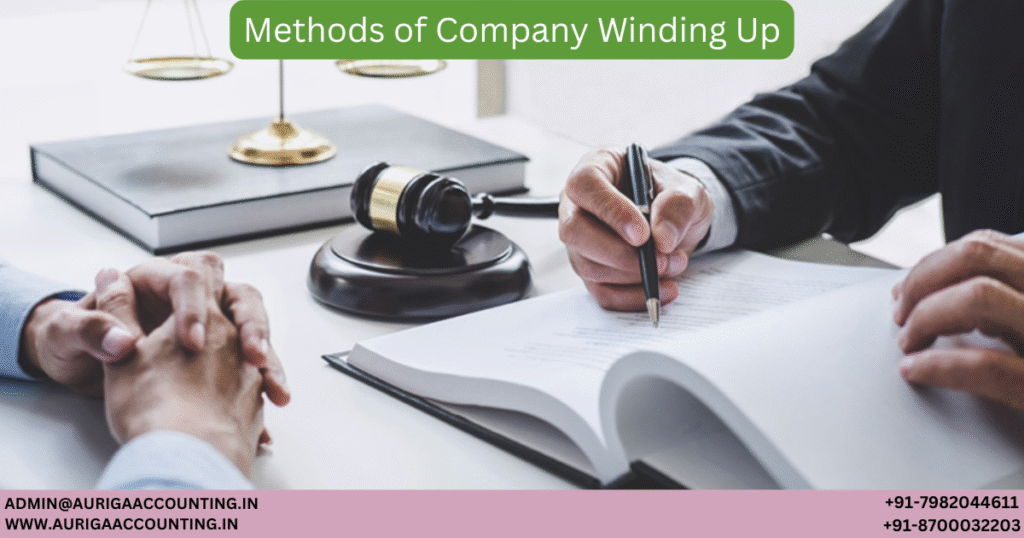
Methods of Company Winding Up
Introduction
ToggleWhat Is the Winding Up of a Company?
Winding up refers to the formal procedure of closing a company, as defined under Section 2(94A) of the Companies Act, 2013. It involves ceasing business operations, selling assets, settling debts, and ultimately dissolving the company. During the process, the company continues to exist as a legal entity and may participate in legal proceedings.
Also read:
Difference Between Winding Up and Dissolution of a Company
Key Aspects of Winding Up
Cessation of Business Activities: The company stops all regular business operations.
Appointment of Liquidator: A liquidator is appointed to manage the winding-up process.
Asset Liquidation: The liquidator collects and sells the company’s assets.
Debt Settlement: Proceeds from asset sales are used to pay creditors.
Distribution of Surplus: Any remaining assets are distributed to shareholders.
Legal Entity Status: The company remains a legal entity throughout the process.
Dissolution: The company is formally dissolved once all steps are completed.
The primary objective of winding up is to ensure an orderly and fair closure, protecting the interests of creditors, employees, and shareholders.
Modes of Winding Up of a Company
Under Section 293 of the Companies Act, 2013, a company may be wound up in three ways:
Compulsory Winding Up (By the Court)
Voluntary Winding Up
Winding Up Under the Supervision of the Court
Compulsory Winding Up
Compulsory winding up is initiated through a court order, usually based on a petition filed by a creditor, the company, or the Registrar of Companies. The court may order winding up in the following situations:
Inability to Pay Debts: A creditor may petition if payment is not received within three weeks of demand.
Special Resolution: The company resolves that it should be wound up by the court.
Default in Statutory Meeting: Failure to hold the statutory meeting or submit the statutory report.
Acts Against National Interest: Activities against the sovereignty or public order of India.
Fraudulent Conduct: If the company’s business is carried out illegally or fraudulently.
Once the order is made, an official liquidator takes charge of the company’s affairs.
Voluntary Winding Up
Voluntary winding up occurs without court intervention and is initiated by the company’s members. There are two types:
1. Members’ Voluntary Winding Up
Initiated when the company is solvent. Directors issue a declaration of solvency, followed by approval from members. A liquidator is appointed to complete the process.
2. Creditors’ Voluntary Winding Up
Initiated when the company is insolvent. After passing a resolution, the company convenes a creditors’ meeting, where creditors play a major role in appointing the liquidator and supervising the process.
In both types, the liquidator is responsible for collecting assets, paying debts, and distributing any remaining surplus.
Winding Up Under the Supervision of the Court
If the court believes that a voluntary winding up is not being conducted properly or requires oversight, it may place the process under its supervision. The winding up then continues as directed by the court.
Procedure for Winding Up a Company in India
Winding up follows a structured legal procedure, which includes:
Resolution or Petition
Voluntary Winding Up: Initiated through a resolution passed in a general meeting; a declaration of solvency is required for solvent companies.
Compulsory Winding Up: Initiated by filing a court petition.
Appointment of Liquidator
Members or creditors appoint the liquidator in voluntary winding up.
The court appoints the official liquidator in compulsory cases.
Publication of Resolution or Court Order
Published in the Official Gazette and a local newspaper to notify stakeholders.
Collection and Realization of Assets
The liquidator takes control of assets, books, and records and sells the assets.
Settlement of Liabilities
Funds are used to settle debts, prioritizing secured creditors, then unsecured creditors, employees, and others.
Distribution of Remaining Assets
Any surplus is distributed to shareholders based on their entitlements.
Final Meeting and Dissolution
A final meeting is held (for voluntary winding up), or the liquidator submits a final report to the court (for compulsory winding up).
The company is then dissolved and its name removed from the Register of Companies.
Filing of Final Documents
The liquidator submits final accounts, the winding-up report, and meeting returns to the Registrar of Companies.
Official Dissolution
Upon verification, the Registrar issues a certificate of dissolution, and the company ceases to exist as a legal entity.
About the Author
Ravi
Ravi is a skilled legal writer who simplifies complex laws into clear, practical guidance. He empowers entrepreneurs by helping them understand their legal obligations, enabling them to build confident, compliant, and sustainable businesses.
April 5, 2026
new
January 6, 2026
January 1, 2026
January 1, 2026
December 31, 2025
December 27, 2025
November 29, 2025
November 27, 2025
November 26, 2025
November 25, 2025
November 25, 2025
November 24, 2025
RELATED ARTICLES

AOC Non-Compliance:...

How to Save...
MCA Rules...
Director KYC:...
LEAP-1 Form:...
No posts found
