Auriga Accounting pvt. ltd. assists companies with AGM planning, statutory notices, and timely filings such as AOC-4, MGT-7, and INC-28—helping you avoid costly penalties.
Don’t risk non-compliance. Get expert support today.


Introduction
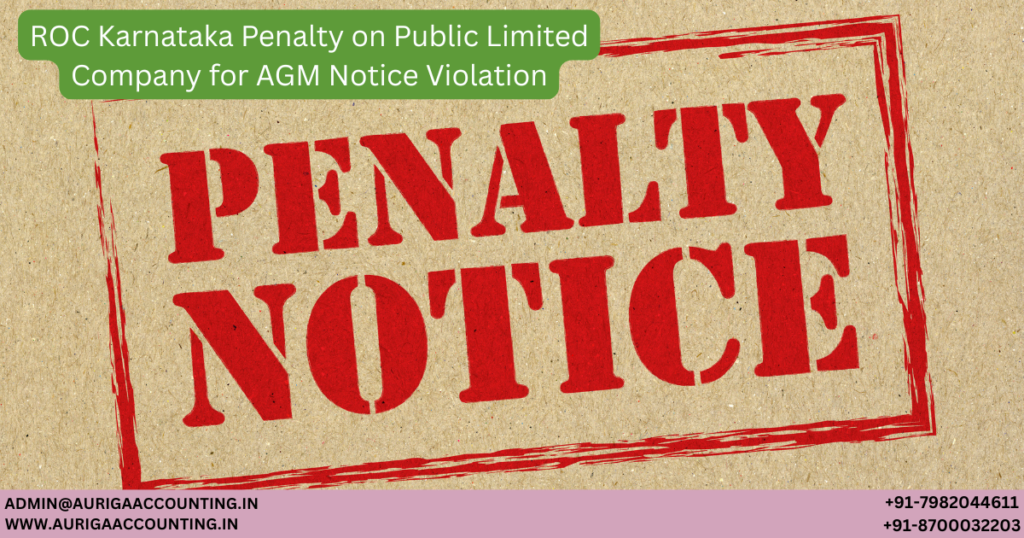
ToggleThe Registrar of Companies (ROC), Karnataka, has levied a total penalty of ₹40,000 on a public limited company and three of its directors for non-compliance with Section 101 of the Companies Act, 2013, which mandates a minimum of 21 clear days’ notice for convening an Annual General Meeting.
The company’s statutory auditor submitted the audit report for FY 2019–20 on December 29, 2020. On the very same day, the company convened and held its Annual General Meeting (AGM) to approve the financial statements.
This raised serious compliance concerns, as there was no indication that shareholders had been given the mandatory 21 clear days’ notice required under the Companies Act, 2013.
In response, the Registrar of Companies (ROC) initiated an inquiry under Section 206(4) read with Section 208 of the Act. The ROC sought and examined key documents, including AGM notices, board minutes, and shareholder consents, to determine whether statutory requirements had been followed.
The matter primarily involved the following provisions of the Companies Act, 2013:
Section 101 – Mandates at least 21 clear days’ notice for general meetings. A shorter notice is permissible only with the consent of 95% of members entitled to vote.
Section 450 – Prescribes a general penalty where no specific penalty is provided for a contravention.
Section 454 – Governs the adjudication of penalties by the ROC.
Rule 3 of the Companies (Adjudication of Penalties) Rules, 2014 – Lays down the procedure for conducting inquiries and imposing penalties.
Section 446B – Provides for lesser penalties for small companies and start-ups; however, this provision was not applicable in the present case.
After reviewing the company’s submissions and conducting a physical hearing on March 6, 2025, the Adjudicating Officer observed that:
The company failed to issue a valid AGM notice in compliance with Section 101.
No documentary evidence was provided to show that 95% of shareholders had consented to a shorter notice period.
As a public limited company, the entity did not qualify as a “small company” under Section 2(85).
Consequently, the benefit of reduced penalties under Section 446B was not available.
The AGM for FY 2019–20 was held on December 29, 2020, the same date on which the audit report was issued. This established that:
The mandatory 21 clear days’ notice was not provided.
No written or electronic consent from 95% of shareholders for shorter notice was obtained.
The AGM was conducted in direct violation of Section 101(1) of the Companies Act, 2013.
The ROC’s inquiry under Sections 206(4) and 208 confirmed these facts after examining:
Copies of notices issued to shareholders, auditors, and directors
Board resolutions authorising the AGM
Written explanations submitted by the company
Under Section 450, the following penalties were imposed:
| Role | Penalty |
|---|---|
| Company | ₹10,000 |
| Director | ₹10,000 |
| Director | ₹10,000 |
| Director | ₹10,000 |
| Total | ₹40,000 |
Compliance Requirements
The company and its officers-in-default are required to:
Pay the penalty within 90 days from the date of receipt of the adjudication order
File Form INC-28 with the ROC as proof of payment
Failure to comply may attract further action under Section 454(8), including additional daily penalties or prosecution.
December 29, 2020 – Audit report submitted and AGM held on the same day
June 10, 2022 – ROC issues notice seeking an explanation
March 15, 2024 – Adjudication notice issued
March 6, 2025 – Physical hearing conducted
July 2025 – Final penalty order issued and published
Ensure payment of penalties within the prescribed 90-day period
File Form INC-28 with the ROC
Avoid further penalties or prosecution under Section 454(8)
1. Strict Compliance with Notice Requirements
Companies must adhere strictly to the 21 clear days’ notice rule. Both the date of dispatch and the date of the meeting are excluded when calculating “clear days.”
2. Importance of Proper Documentation
Maintain clear records of:
AGM/EGM notices
Board resolutions
Shareholder consents (if shorter notice is used)
3. Shorter Notice Requires 95% Consent
Shorter notice is valid only if 95% of voting shareholders provide written or electronic consent.
4. Directors Can Be Personally Penalised
Directors designated as officers-in-default may be held individually liable for procedural lapses.
5. Section 446B Relief Not Available to Public Companies
Only small companies and start-ups can claim reduced penalties. Public companies must comply fully.
For most companies, the AGM for FY 2024–25 must be held by September 30, 2025, unless an extension is granted.
Best practices:
Begin planning at least 60 days in advance
Issue 21 clear days’ notice
File AOC-4 and MGT-7 within statutory timelines
Auriga Accounting pvt. ltd. assists companies with AGM planning, statutory notices, and timely filings such as AOC-4, MGT-7, and INC-28—helping you avoid costly penalties.
Don’t risk non-compliance. Get expert support today.
Dakesh
Dakesh simplifies complex legal regulations into clear, actionable guidance, enabling entrepreneurs to remain compliant and build sustainable businesses with confidence.