

When you think of your favorite brands, their distinctive logos, names, or slogans likely stand out immediately. These elements are more than marketing tools—they are legally protected assets that provide businesses with a competitive edge. Trademark registration not only secures legal protection but also establishes a strong and recognizable brand identity that resonates with consumers. However, obtaining a trademark in the US requires meeting specific legal standards that define what is and isn’t eligible for protection. This guide outlines the key considerations businesses should understand before applying for US trademark registration. The experts at Auriga Accounting pvt. ltd. are ready to support you through every step of the process, ensuring your brand receives the protection it deserves.
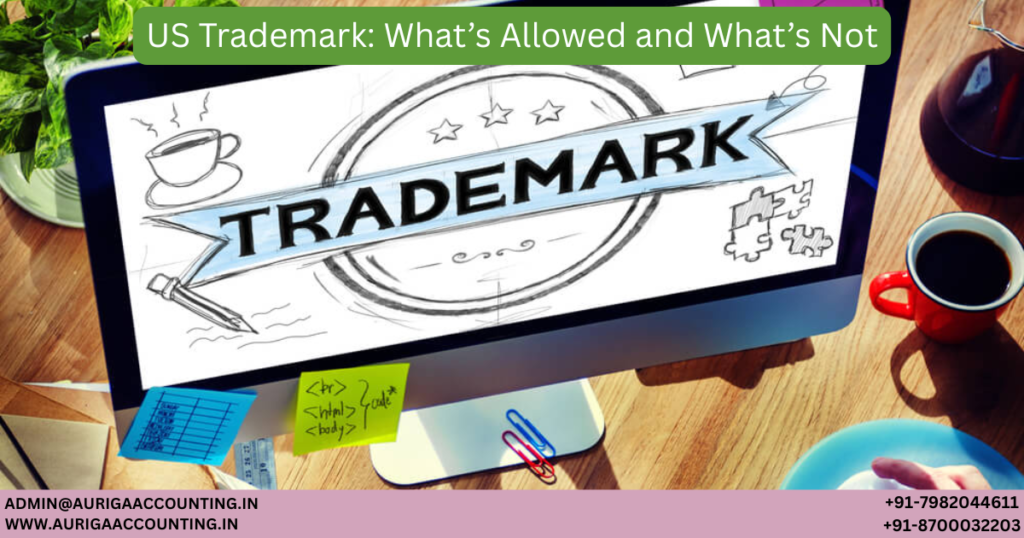
US Trademark: What’s Allowed and What’s Not
Introduction
ToggleTrademark
A trademark is a distinctive sign, symbol, word, phrase, design, or combination of these elements used to identify and distinguish one business’s goods or services from those of others. It functions as a brand identifier and may include company names, logos, product names, slogans, packaging, or other recognizable features. Trademarks help protect brand identity, enable consumers to identify the source of goods or services, and reduce confusion in the marketplace. While the term trademark typically applies to goods, service mark is used for services.
What Is a Registered Trademark in the US?
A registered trademark is one that has been formally approved and recorded with the United States Patent and Trademark Office (USPTO). Federal registration grants the owner exclusive nationwide rights to use the mark in connection with the listed goods or services. It also provides significant legal benefits, including the right to bring infringement actions in federal court and the potential to claim enhanced damages. Registered trademarks are denoted by the ® symbol and serve as public notice of ownership. Federal registration is the strongest form of trademark protection in the US, offering robust safeguards for a brand’s core identity.
Why US Trademark Registration Matters
Trademark registration strengthens brand protection, deters infringement, and enhances credibility in the marketplace. It secures exclusive rights, supports enforcement, and adds value to your business as an intangible asset.
Understanding Trademark Distinctiveness and Eligibility
To qualify for registration, a trademark must be distinctive—capable of identifying and distinguishing the source of goods or services. Trademarks fall into five categories of distinctiveness:
Generic Marks: Common names for products or services (e.g., “Bread” for bakery goods) are not registrable.
Descriptive Marks: Terms that directly describe a product or service (e.g., “Sharp” for TVs) are registrable only after acquiring distinctiveness through extensive use.
Suggestive Marks: Marks that hint at qualities or characteristics (e.g., “Netflix”) are inherently registrable.
Arbitrary Marks: Common words used in an unrelated context (e.g., “Apple” for electronics) are strong and registrable.
Fanciful Marks: Invented terms with no prior meaning (e.g., “Kodak”) receive the highest level of protection.
Functional and Prohibited Marks
Marks that are purely functional—such as essential product shapes or features—cannot be registered. Other prohibited marks include common surnames without acquired distinctiveness, purely descriptive or promotional phrases, misleading marks, and those too similar to existing trademarks.
Key Steps and Considerations for Effective Trademark Registration
Before applying, ensure your mark is unique and unlikely to cause confusion with existing trademarks. Conducting a comprehensive trademark search is essential. Generic terms, overly descriptive marks, and surnames typically face challenges unless they’ve gained strong brand recognition. Recent legal developments have expanded eligibility in certain areas, making professional guidance valuable.
Auriga Accounting pvtl. ltd. an help assess eligibility, conduct thorough searches, and navigate the registration process to protect your brand effectively.
What Can Be Trademarked in the US?
Any element used in commerce that identifies and distinguishes the source of goods or services may be trademarked, provided it is distinctive. Common examples include:
Names: Business or product names that are unique and non-generic.
Logos: Stylized designs, symbols, or wordmarks.
Phrases and Slogans: Distinctive marketing phrases associated with your brand.
Product Names: Specific names used for goods or services.
Additional, less conventional trademarks may include:
Colours: When a specific colour identifies the brand (e.g., Tiffany Blue).
Sounds: Distinctive audio cues associated with a brand (e.g., MGM’s lion roar).
Shapes: Unique product or packaging shapes (e.g., the Coca-Cola bottle).
Characters: Recognizable brand mascots or characters (e.g., the Geico Gecko).
The key is that the mark must function as a source identifier and be distinguishable from competitors.
What Cannot Be Trademarked?
The USPTO generally refuses registration for:
Generic Terms: Common industry terms needed for public use.
Merely Descriptive Terms: Unless they’ve acquired secondary meaning.
Geographical Terms: When they simply describe the origin of goods or services.
Common Surnames: Without proven brand recognition.
Government Insignias: Flags, seals, or official emblems.
Deceptively Misdescriptive Marks: Those that falsely describe a product or service.
Functional Features: Essential product features affecting use, cost, or quality.
Confusingly Similar Marks: Those likely to cause consumer confusion.
Misleading or Deceptive Marks: That misrepresent nature, quality, or origin.
Names of Living Individuals: Without their consent.
Understanding both what can and cannot be trademarked is essential to ensuring your application is eligible, enforceable, and does not infringe on existing rights.
About the Author
Dakesh
Dakesh breaks down complex legal regulations into clear, practical insights, helping entrepreneurs stay compliant while confidently growing sustainable, scalable businesses.
new
RELATED ARTICLES