Ravi
Ravi simplifies complex legal regulations into practical, easy-to-follow guidance, enabling entrepreneurs to remain compliant and build sustainable businesses with confidence


Introduction
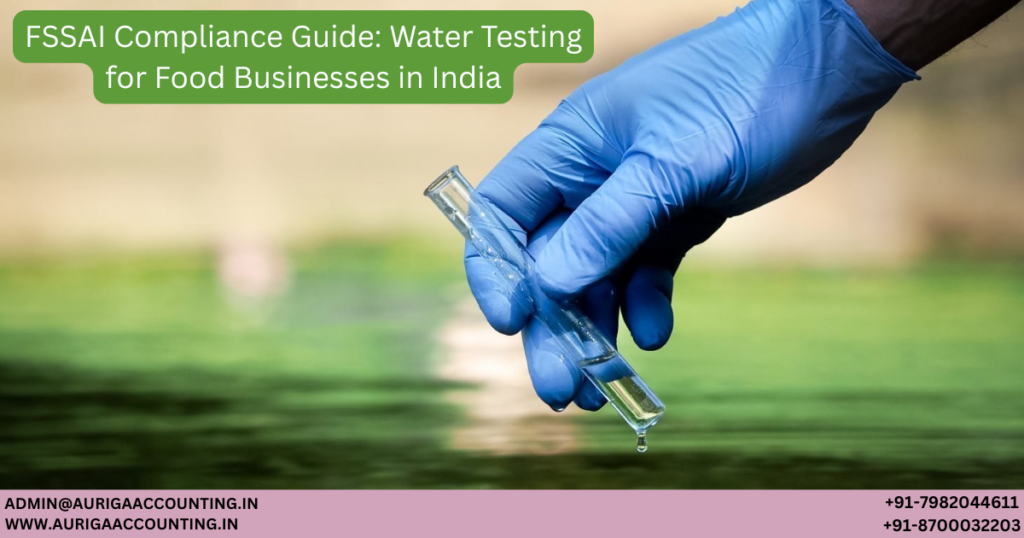
ToggleAccess to clean and safe water is not only essential for public health but also a statutory requirement for food businesses in India. The Food Safety and Standards Authority of India (FSSAI) mandates that all food business operators (FBOs) use water that meets prescribed quality standards. From street food vendors to large-scale food manufacturing units, any water used for food preparation, processing, cleaning, or sanitation must be potable and regularly tested.
This article explains the importance of FSSAI-compliant water testing, applicable legal requirements, testing frequency, parameters evaluated, documentation needs, and how food businesses can achieve compliance easily and cost-effectively.
Partner with Auriga Accounting pvt. ltd. for dependable, NABL-accredited water testing services specifically designed for food businesses.
The Food Safety and Standards Authority of India (FSSAI), established under the Food Safety and Standards Act, 2006, is responsible for regulating food safety across the country. One of the most critical components of food safety is the quality of water used during food handling and production.
FSSAI requires all food businesses to use potable water, defined as water that complies with the Bureau of Indian Standards (BIS) IS 10500 specifications. This requirement applies not only to water used as an ingredient, but also to water used for washing raw materials, cleaning equipment, processing, and employee hygiene.
Water can act as a carrier for harmful microorganisms, toxic chemicals, and heavy metals. In food operations, poor water quality can create serious risks, including:
Food Contamination: Introduction of pathogens such as E. coli, Salmonella, and Hepatitis A
Consumer Health Risks: Foodborne illnesses resulting from contaminated food or beverages
Operational Issues: High TDS or hardness can damage equipment and affect product quality
Regulatory Action: Failure to maintain testing records or meet standards may lead to penalties, license suspension, or business closure
FSSAI-compliant water testing applies to all food business operators, including:
Restaurants and cafés
Food processing units
Packaged drinking water manufacturers
Cloud kitchens
Dairy, poultry, and meat processing units
Bakeries and confectionery units
Beverage manufacturers
Caterers and street food vendors
Even businesses that outsource food production or packaging are strongly advised to conduct independent water testing to ensure compliance.
FSSAI recommends that water used in food handling and preparation be tested at least twice a year through a NABL-accredited laboratory. Businesses with higher water consumption, borewell sources, or known contamination risks should conduct testing quarterly or more frequently.
FSSAI water testing typically covers the following categories:
1. Microbiological Parameters
Total Coliforms
E. coli
Salmonella
Yeast and Mold (especially for packaged drinking water)
2. Chemical Parameters
pH
Total Dissolved Solids (TDS)
Total Hardness
Chloride
Fluoride
Nitrates
Heavy Metals (Lead, Arsenic, Mercury, Cadmium)
3. Physical Parameters
Turbidity
Colour
Odour
Taste
Additional parameters may be required depending on the nature of the business, such as ice manufacturing or packaged water production.
During inspections, FSSAI officials may request the following records:
Latest water test reports (not older than six months)
NABL laboratory accreditation certificate
Details of water sources (municipal supply, borewell, RO, etc.)
Log of water usage points
Records of corrective actions taken for failed results
Maintaining proper documentation is essential to demonstrate ongoing compliance.
Routine water testing offers several advantages beyond legal compliance:
Consumer Safety: Ensures food and beverages are safe for consumption
Regulatory Compliance: Avoids fines, license suspension, or operational shutdowns
Brand Trust: Enhances credibility with customers and authorities
Operational Efficiency: Clean water improves equipment life and product consistency
Audit Readiness: Supports ISO, HACCP, and FSSAI audits
Early Detection: Identifies potential contamination before it becomes a serious issue
Ensuring compliance is simple when approached systematically:
Step 1: Identify Water Usage Points
List all locations where water comes into contact with food, utensils, equipment, or employees.
Step 2: Select a NABL-Accredited Laboratory
FSSAI accepts reports only from NABL-certified labs. Auriga Accounting pvt. ltd. works with accredited labs across India.
Step 3: Sample Collection
Collect samples using sterile containers and prescribed protocols, or opt for professional sample collection services.
Step 4: Obtain the Test Report
Receive a detailed report indicating parameter values and compliance status.
Step 5: Take Corrective Measures if Required
If any parameter fails, install or maintain appropriate treatment systems such as RO or UV purification and re-test.
Ravi
Ravi simplifies complex legal regulations into practical, easy-to-follow guidance, enabling entrepreneurs to remain compliant and build sustainable businesses with confidence