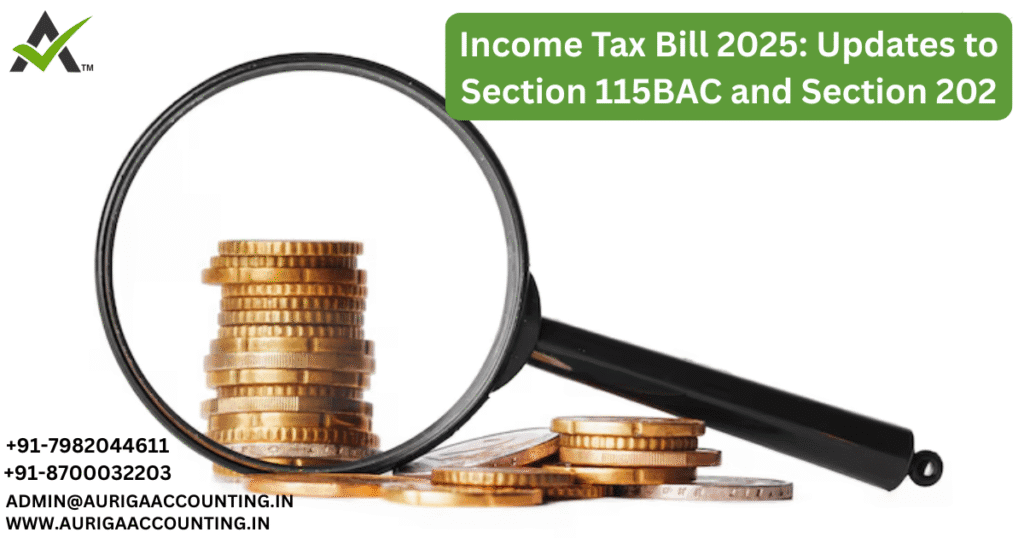
Income Tax Bill 2025: Updates to Section 115BAC and Section 202
Introduction
ToggleThe Income Tax Bill 2025 introduces significant reforms aimed at simplifying the Income-tax Act, 1961. One of the key changes is the relocation of provisions related to the new tax regime from Section 115BAC to a newly designated Section 202. Effective from April 1, 2026, this shift is intended to streamline the legislation without altering the existing tax slabs and rates. The new section will consolidate the framework of the new tax regime, directly impacting individual taxpayers, domestic companies, cooperative societies, and other eligible entities. This article provides a comprehensive overview of these updates and their implications.
What is Section 115BAC of the Income-tax Act, 1961?
Section 115BAC of the Income-tax Act, 1961, offers an optional tax regime for individuals and Hindu Undivided Families (HUFs) whose income does not include profits or gains from business or profession. Introduced in the financial year 2020–21, this regime features reduced tax slab rates and became the default tax option starting from the financial year 2023–24.
While the new regime provides lower tax rates, it requires taxpayers to forgo several deductions and exemptions that are otherwise available under the old tax system. It was designed to offer a simplified alternative for taxpayers seeking a straightforward tax computation without the complexity of multiple deductions
Changes to Section 115BAC Under the Income Tax Bill 2025
The Income Tax Bill 2025 introduces a structural shift by relocating the provisions of the current tax regime under Section 115BAC to a newly created Section 202. This amendment, effective from April 1, 2026, is aimed at improving the organization and clarity of the Income-tax Act.
Although the tax slabs and rates under the new regime remain unchanged, the repositioning reflects the government’s intent to simplify the tax law while preserving the key benefits of the existing regime. The dedicated Section 202 will continue to apply to eligible taxpayers, including individuals, domestic companies, cooperative societies, and others, offering a cleaner and more navigable legal framework
Income Tax Slabs and Rates Under Section 202
Under Section 202 of the Income Tax Bill 2025, the income tax slabs and rates remain consistent with those previously outlined in Section 115BAC. The basic exemption limit is set at ₹4 lakh, and income exceeding ₹24 lakh will be subject to the highest tax rate of 30%.
It is important to note that the new tax regime under Section 202 continues to disallow most deductions and exemptions that are available under the old regime. This structure aims to provide a simplified and uniform tax calculation for eligible taxpayers.
Below are the applicable income tax slabs and rates as specified under Section 202:
| Sl. No. | Total Income | Rate of Tax |
|---|---|---|
| 1 | Up to ₹4,00,000 | Nil |
| 2 | ₹4,00,001 to ₹8,00,000 | 5% |
| 3 | ₹8,00,001 to ₹12,00,000 | 10% |
| 4 | ₹12,00,001 to ₹16,00,000 | 15% |
| 5 | ₹16,00,001 to ₹20,00,000 | 20% |
| 6 | ₹20,00,001 to ₹24,00,000 | 25% |
| 7 | Above ₹24,00,000 | 30% |
This structured rate system continues to apply to individuals, HUFs, domestic companies, cooperative societies, and other eligible taxpayers opting for the new regime
Tax Rebate Under Section 156 of the New Income Tax Bill
Section 156 of the Income Tax Bill 2025 introduces a new rebate mechanism aimed at reducing the tax burden for individuals under the new tax regime. This rebate is independent of the existing rebate under Section 87A of the Income-tax Act, 1961, and is specifically tailored to encourage adoption of the new simplified tax structure.
Key Rebate Provisions Under Section 156:
For income up to ₹12 lakh:
Taxpayers are eligible for a rebate equal to 100% of the income tax payable or ₹60,000 — whichever is lower. This effectively makes income up to ₹12 lakh tax-free under the new regime.For income exceeding ₹12 lakh:
A tapered rebate is provided. The rebate amount equals the tax payable on the total income minus the tax on the portion exceeding ₹12 lakh. This ensures a gradual phase-out of benefits as income rises above ₹12 lakh.For taxpayers under the old regime:
A maximum rebate of ₹12,500 is available, but only if the total income does not exceed ₹5 lakh — similar to the existing provision under Section 87A.
This new rebate structure is designed to provide significant relief to middle-income taxpayers, enhance progressivity, and simplify the tax system under the new regime
About the Author
Priya
Priya is a seasoned content writer with expertise in business registration, tax regulations, trademark laws, and corporate compliance. His well-researched articles offer practical insights and straightforward guidance, empowering businesses to navigate complex legal and regulatory frameworks with confidence and clarity
new
RELATED ARTICLES