

Skip to content
Auriga accounting
Edit Content
auriga accounting
AURIGA ACCOUNTING PRIVATE LIMITED Untitled 1200 x 630 px 82

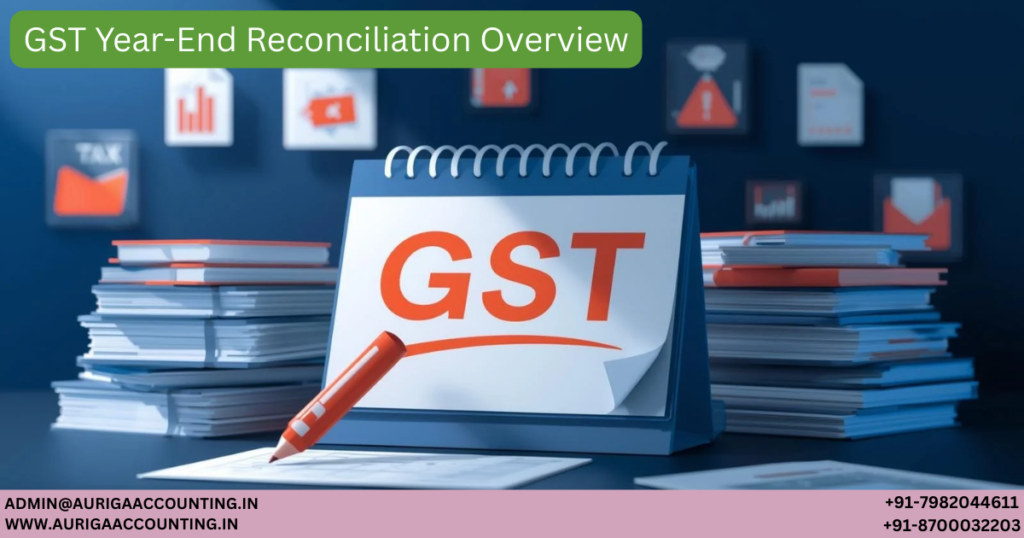
As the financial year (FY 2023–24) has concluded, GST-registered businesses must review their GST return filings to ensure accuracy and compliance. Proper verification helps prevent mismatches that could result in penalties, interest, or legal issues.

Year-end GST reconciliation plays a crucial role in identifying discrepancies that may go unnoticed during periodic reconciliations. It involves a detailed comparison of GSTR-1, GSTR-3B, and the books of accounts to ensure consistency across all records.

This article provides comprehensive insights into year-end GST reconciliation, its significance, and the key steps to carry it out efficiently. For a smooth and accurate GST reconciliation process, connect with the experts at Auriga Accounting pvt.ltd. today.

What Are Year-End GST Reconciliations?

Year-end GST reconciliation is a comprehensive review of all GST-related transactions undertaken by a business during the entire financial year. It involves systematically comparing GST returns filed (various GSTR forms) with the books of accounts to verify accuracy and completeness. This in-depth exercise helps uncover discrepancies or errors that may not have been detected during periodic or routine reconciliations.

Key Elements of Year-End GST Reconciliation

A thorough year-end GST reconciliation typically includes the following components:

1. GST Returns

  • GSTR-1 (Outward Supplies):
    This return captures details of all outward supplies made during the year. The figures reported in GSTR-1 must be reconciled with sales invoices and the sales ledger to ensure all outward transactions are correctly disclosed.

  • GSTR-3B (Summary Return):
    GSTR-3B summarizes tax liability and Input Tax Credit (ITC) claimed. The data should be matched with accounting records to confirm the accuracy of tax payments and ITC utilization.

  • GSTR-9 (Annual Return):
    This return consolidates all GST-related transactions for the financial year. It must align with the books of accounts and other GST returns to ensure consistency.

2. Books of Accounts

This includes data from accounting software and financial records such as:

  • Sales and Purchase Ledgers:
    These ledgers should match with GSTR-1 (sales) and GSTR-2A/2B (purchases).

  • Invoices:
    Sales and purchase invoices for the entire year must be available to validate GST returns.

  • E-way Bills (if applicable):
    For businesses dealing in goods above the prescribed value threshold, e-way bill details must align with invoices and GSTR-1 entries.

3. Reconciliation Statement (GSTR-9C)

Taxpayers with an annual turnover exceeding ₹5 crore are required to file GSTR-9C, which reconciles GSTR-9 with audited financial statements.

Why Is Year-End GST Reconciliation Important?

Year-end GST reconciliation offers multiple benefits, including:

  • Accuracy in GST Filings:
    Identifying and correcting errors before final submission reduces the risk of penalties and notices.

  • Detection of ITC Mismatches:
    Helps ensure that ITC claimed matches supplier data, preventing loss of eligible credits or excess claims.

  • Avoidance of Tax Liabilities:
    Early detection of discrepancies helps avoid underpayment or overpayment of GST.

  • Improved Record-Keeping:
    Strengthens internal controls and ensures a clear audit trail for future assessments or audits.

Steps for an Efficient Year-End GST Reconciliation
  1. Collect All Relevant Documents:
    Gather GSTR-1, GSTR-3B, GSTR-9, sales and purchase ledgers, invoices, and e-way bills (if applicable).

  2. Reconcile GSTR-1 with Books of Accounts:

    • Ensure all sales recorded in books are reported in GSTR-1.

    • Match outward supply values with GSTR-3B.

    • Reconcile e-invoices and e-way bills with GSTR-1, where applicable.

  3. Reconcile GSTR-3B with Accounting Records:

    • Compare taxable turnover, ITC claimed, and tax liability with books of accounts.

    • Identify and rectify discrepancies.

  4. Reconcile GSTR-9 with Books of Accounts:

    • Match annual sales, purchases, ITC, and tax liability with accounting records.

    • Ensure consistency across all filings.

  5. Reconcile Input Tax Credit (ITC):

    • Compare ITC claimed in GSTR-3B with GSTR-2A/GSTR-2B.

    • Identify missing or excess ITC claims and take corrective action.

    • Verify eligibility of ITC as per GST provisions to avoid ineligible claims.

  6. Reconcile E-way Bills (If Applicable):

    • Match e-way bill details with sales invoices and GSTR-1 entries.

    • Rectify mismatches to avoid penalties.

  7. Prepare GSTR-9C (If Applicable):

    • Use reconciled data to accurately prepare and file GSTR-9C.

    • Ensure figures match audited financial statements.

  8. Maintain Proper Records:

    • Preserve all reconciliation reports, GST returns, invoices, and supporting documents.

    • This ensures smooth audits and simplifies future reconciliations.

Best Practices for Year-End GST Reconciliation
  • Start Early: Perform reconciliations periodically throughout the year to reduce year-end pressure.

  • Keep Records Organized: Maintain systematic documentation of all GST-related records.

  • Use Technology: Leverage accounting or GST reconciliation software to reduce manual errors.

  • Seek Expert Assistance: For complex issues or large volumes of data, consult experienced GST professionals such as Auriga Accounting pvt. ltd. tax advisors for accurate and efficient reconciliation.

About the Author

Dakesh

Dakesh breaks down complex legal regulations into clear, actionable guidance, helping entrepreneurs stay compliant while building sustainable and scalable businesses.

May 13, 2026

new

RELATED ARTICLES

what is minute book - 2026-05-13T170625
CERTIFICATE OF INCUMBENCY
Incumbency...
what is minute book - 2026-05-12T110238
BARCODE REGISTRATION
Apply Now...
what is minute book - 2026-05-11T155335
PROFESSIONAL TAX REGISTRATION
Professional...
what is minute book - 2026-05-09T141359
TRUST REGISTRATION
Trust Registration...
what is minute book - 2026-05-09T135601
EMUDHRA DIGITAL SIGNATURE CERTIFICATE
eMudhra DSC...
what is minute book - 2026-05-08T145956
COMPANY ANNUAL FILING
What is Company...
what is minute book - 2026-05-08T143056
PROPRIETORSHIP COMPLIANCE
Sole Proprietorship...
what is minute book - 2026-05-08T121401
TRADEMARK RENEWAL
Trademark...
what is minute book - 2026-05-07T153935
GUIDE FOR BUSINESS & PROFESSIONAL
Presumptive...
×