
Skip to content
Auriga accounting
Edit Content
auriga accounting
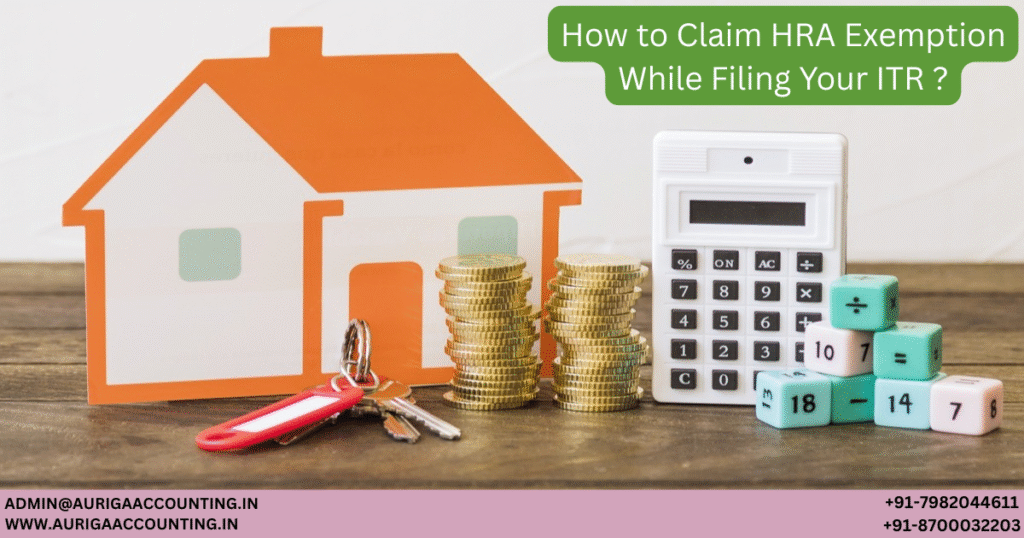
AURIGA ACCOUNTING PRIVATE LIMITED How to Claim HRA Exemption While Filing Your ITR

House Rent Allowance (HRA) is a salary component provided by employers to help employees meet their rental expenses. Understanding how HRA works and how much of it can be claimed as a tax exemption is crucial for salaried taxpayers. Individuals living in rented accommodation can claim HRA exemption under Section 10(13A) of the Income Tax Act by choosing the lowest value among the HRA received, the rent paid minus 10% of basic salary, or the applicable percentage based on their city of residence.

This article covers everything you need to know about HRA—eligibility criteria, required documents, calculation methods, and how to claim it while filing your ITR. Auriga Accounting pvt. ltd. makes the ITR filing process simple and hassle-free with expert support!


What Is House Rent Allowance (HRA)?

House Rent Allowance (HRA) is a component of your salary provided by your employer to help you meet rental expenses. It also offers a tax benefit—but the exempt portion depends on factors such as your basic salary, HRA received, rent paid, and whether you live in a metro (eligible for up to 50% of basic salary) or non-metro city (eligible for up to 40%).
To claim tax exemption, you must submit valid rent receipts and, in some cases, your landlord’s PAN.

Eligibility Criteria for Claiming HRA Exemption

You can claim HRA exemption under the Income Tax Act only if you meet the following conditions:

1. Salaried Employee

HRA exemption is available only to salaried individuals. Self-employed taxpayers cannot claim it.

2. HRA Must Be Part of Salary

Your salary structure should include a House Rent Allowance component.

3. Living in Rented Accommodation

You must be staying in a rented house and paying rent. HRA cannot be claimed if you live in your own property.

4. Proof of Rent Payment

Submit original rent receipts or rent payment details to your employer.

5. Landlord’s PAN (If Applicable)

If your annual rent exceeds ₹1,00,000, your landlord’s PAN must be shared with your employer.

6. Old Tax Regime

HRA exemption is available only under the old tax regime.

Documents Required to Claim HRA Exemption

To claim HRA exemption, you generally need the following:

1. Rent Receipts

Must include the date, tenant and landlord names, property address, rent amount, and duration.

2. Rental Agreement

A valid rent agreement for the current financial year.

3. Landlord’s PAN

Mandatory only if yearly rent exceeds ₹1,00,000.

4. HRA Declaration

Some employers require a declaration detailing rent paid and HRA received.

5. Utility Bills (Optional)

Electricity, water, or gas bills can serve as additional proof of residence.

Employers use these documents to calculate HRA exemption and reflect it in Form 16. Even if you miss submitting them, you can still claim HRA directly while filing your ITR.

How Much HRA Exemption Can You Claim?

The exempt amount of HRA is the lowest of the following three values:

  1. Actual HRA received from your employer.

  2. 50% of basic salary + DA (for metro cities) or 40% (for non-metros).

  3. Rent paid minus 10% of basic salary.

If your salary or rent changes during the year, you must calculate this month-wise; otherwise, an annual calculation works.

How Is HRA Exemption Calculated? (Example)

Example — Mr. Raj (Non-metro city):

  • Basic Salary: ₹40,000/month

  • DA: ₹5,000/month (assumed)

  • HRA Received: ₹12,000/month

  • Rent Paid: ₹18,000/month

1. Actual HRA received

₹12,000 × 12 = ₹1,44,000

2. 40% of Salary (Basic + DA)

40% × (₹40,000 + ₹5,000) × 12 = ₹1,92,000

3. Rent paid – 10% of Basic

Annual Rent = ₹18,000 × 12 = ₹2,16,000
10% of Basic = ₹48,000
Excess Rent = ₹2,16,000 – ₹48,000 = ₹1,68,000

Lowest of the three = ₹1,44,000

Thus, Mr. Raj can claim ₹1,44,000 as HRA exemption.

How to Claim HRA Exemption While Filing Your ITR

If you miss submitting Form 12BB to your employer, you can still claim HRA during ITR filing. Follow these steps:

  1. Calculate eligible HRA using the three-step rule.

  2. Compute your taxable income after deducting HRA and other tax benefits.

  3. Choose the correct ITR form as per your income profile.

  4. Enter HRA details in the HRA section of the ITR form.

  5. Upload supporting documents such as rent receipts and rental agreement.

Can You Claim Both HRA and Home Loan Interest?

Yes, you can claim both—provided:

  • You pay rent for your current residence (for HRA exemption), and

  • You have a home loan for another property (owned or co-owned).

HRA applies only to your rented accommodation, while home loan interest deduction applies to the property on which the loan is taken. Keep all relevant documents for verification.

Tips to Avoid HRA Exemption Rejection in Your ITR

To ensure smooth processing:

✔ Maintain a Valid Rent Agreement

Include details of rent amount, landlord information, and duration.

✔ Keep Rent Receipts

Even for online payments, keep monthly or quarterly receipts.

✔ Prefer Digital Rent Payments

Avoid cash payments—especially above ₹2 lakh—as they may attract penalties.

✔ Provide Landlord’s PAN If Required

Mandatory for rent above ₹1 lakh per year.

✔ Renting From Family? Keep Proper Proof

Have a rent agreement, receipts, and ensure the family member reports rent as income.

What If You Don’t Receive HRA? (Section 80GG)

If your salary doesn’t include HRA, you can still claim a deduction for rent paid under Section 80GG, if:

  • You are salaried or self-employed,

  • You do not receive HRA,

  • Rent exceeds 10% of your total income,

  • You do not own a home in the city where you reside.

About the Author

Ravi

  • Ravi is an experienced legal writer who simplifies complex laws into clear, practical guidance. He empowers entrepreneurs to understand their legal obligations so they can build compliant, sustainable businesses with confidence

February 21, 2026

new

RELATED ARTICLES

Untitled (1200 x 630 px) - 2026-01-10T150331
Key Reasons for Receiving an Income Tax Notice
Key Reasons...
Untitled (1200 x 630 px) (99)
Simple Tax-Saving Strategies for Salaried Employees
Simple Tax-Saving...
Untitled (1200 x 630 px) (97)
File Your Income Tax Return with Pay Later Option
File Your...
Untitled (1200 x 630 px) (92)
Tax Saving Options Beyond Section 80C
Tax Saving...
Untitled (1200 x 630 px) (91)
Section 80GGA: Tax Deductions for Scientific Research Donations
Section 80GGA:...
Untitled (1200 x 630 px) (90)
Form 10IE or Form 10IEA: Which Form Is Right for You?
Form 10IE...
Untitled (1200 x 630 px) (89)
Guide to Income Tax Notices for Salaried Employees
Guide to Income...
Untitled (1200 x 630 px) (88)
How to Verify and Authenticate an Income Tax Notice Online
How to Verify...
Untitled (1200 x 630 px) (87)
Handling Income Tax Notices on High-Value Cash Transactions
Handling Income...
×