Skip to content
Auriga accounting
Edit Content
auriga accounting
AURIGA ACCOUNTING PRIVATE LIMITED Untitled 1200 x 630 px 89

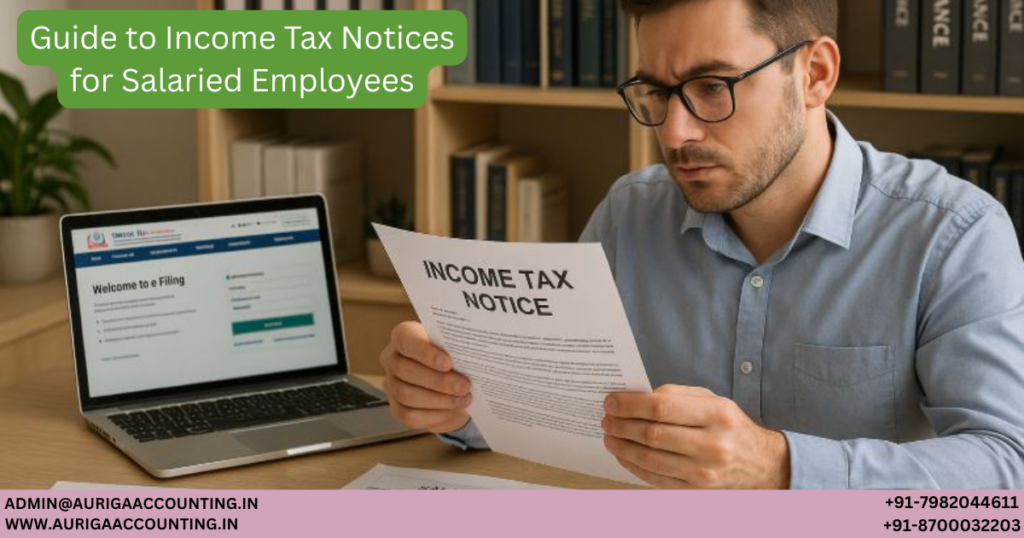
An income tax notice is an official communication from the Income Tax Department seeking clarification, corrections, or additional information regarding your tax filings. In the current financial year, the issuance of income tax notices to salaried individuals has increased significantly. Tax authorities are now leveraging advanced technologies, including AI-based systems, to detect discrepancies such as incorrect or fraudulent claims, unreported income, non-filing of returns, inconsistencies in submitted returns, and high-value transaction alerts.

As a result, salaried taxpayers with undisclosed income or unsupported deductions are more likely to receive a notice. This guide covers everything you need to know about income tax notices for salaried employees, including the correct way to respond to them. The experienced tax professionals at Auriga Acconting pvt. ltd. are available to assist you with accurate filing and effective resolution of any income tax notices you may receive.
What Is an Income Tax Notice?

An income tax notice is an official communication issued by the Income Tax Department to taxpayers—individuals or organisations—regarding matters related to their tax filings. These notices are sent to highlight issues such as tax dues, discrepancies in returns, incorrect claims, or the need for additional verification or audit.

Income tax notices may be triggered by unreported income, incorrect deduction or refund claims, mismatches in reported information, or non-compliance with filing requirements. The notice informs the taxpayer of the identified issue and may require submission of additional documents, correction of errors, or clarification of inconsistencies. Responding accurately and within the prescribed deadline is essential to remain compliant and avoid penalties or further legal consequences.

Reasons Income Tax Notices Are Issued to Salaried Employees

Salaried individuals may receive income tax notices for several reasons, including:

  • Income Mismatch: Differences between income reported in the ITR and information submitted by employers, banks, or other financial institutions.

  • Unreported Income: Failure to disclose additional income sources such as rent, interest, freelancing income, or side gigs.

  • Incorrect or Unsupported Deductions: Claiming deductions or exemptions without proper eligibility or documentation, including fraudulent claims like fake rent receipts for HRA.

  • High-Value Transactions: Significant financial activities such as large cash deposits, property purchases, or substantial investments that require verification.

  • Form 26AS Mismatch: Discrepancies between the income declared in the ITR and details reflected in Form 26AS.

  • Non-Filing or Delayed Filing: Failure to file returns or filing after the due date.

  • Random Scrutiny: Returns may be selected randomly for detailed examination to ensure compliance.

  • Foreign Income or Assets: Non-disclosure of foreign income or overseas assets as required under tax laws.

  • Unreported Gifts or Loans: Failure to disclose gifts or loans exceeding prescribed thresholds.

  • Ignoring Previous Notices: Non-response or incomplete responses to earlier notices can result in escalated action.

If you receive a notice for any of these reasons, timely and accurate action is critical.

Types of Income Tax Notices for Salaried Employees

Below are the most common income tax notices issued to salaried taxpayers:

  • Intimation under Section 143(1): Issued after processing the ITR, detailing tax computation, refunds, or additional tax payable.

  • Notice under Section 142(1): Issued when additional information or documents are required, or when the taxpayer has not filed an ITR. Non-compliance may attract penalties or prosecution.

  • Notice under Section 148: Issued when income is believed to have escaped assessment due to underreporting or non-filing.

  • Notice under Section 139(9): Known as a defective return notice, issued when errors or missing details are found. The taxpayer must rectify defects within 15 days.

  • Notice under Section 143(2): Indicates selection of the return for scrutiny to verify income, deductions, and tax payments.

  • Notice under Section 156: A demand notice issued when tax dues, penalties, or interest are payable, requiring payment within 30 days.

  • Notice under Section 245: Issued when the department proposes to adjust a refund against outstanding tax dues from previous years.

Each notice requires a specific response and must be handled carefully.

How to Respond to Income Tax Notices for Salaried Employees

Effectively addressing an income tax notice requires a systematic approach:

  1. Review the Notice Carefully: Understand the reason for issuance and the action required.

  2. Gather Relevant Documents: Compile documents such as Form 16, Form 26AS, bank statements, investment proofs, and ITR copies.

  3. Meet Deadlines: Respond within the timeline mentioned to avoid penalties or escalation.

  4. Submit Supporting Evidence: Provide clear and complete documentation to substantiate your response.

  5. Seek Professional Assistance: If the notice is complex, consult tax professionals for guidance.

  6. Confirm Submission: Ensure your response is acknowledged on the tax portal.

  7. Monitor Follow-Ups: Regularly check for additional communications or requests from the department.

A proactive and organized response can help resolve notices smoothly.

Increased Scrutiny on False Deduction Claims by Salaried Taxpayers

The Income Tax Department has significantly tightened scrutiny of salaried individuals claiming false deductions and exemptions. A sharp rise in notices—particularly related to House Rent Allowance (HRA) and rent-based claims—has been observed, often involving fake rent receipts.

While deductions such as HRA, LTA, home loan interest, and donations are legitimate tax benefits, misuse through fabricated documentation has prompted stricter enforcement. The department now uses advanced AI-driven systems to identify fake documents and flag fraudulent deduction claims.

Taxpayers must ensure that:

  • HRA claims are supported by genuine rent receipts

  • LTA claims are backed by valid travel documents

  • All deductions and exemptions are supported by authentic evidence

AI-based scrutiny extends beyond HRA and LTA to cover a wide range of deductions, including charitable donations. Any suspicious or fraudulent claim may result in a notice.

How Salaried Taxpayers Can Avoid Income Tax Notices and Penalties

To minimize the risk of notices and penalties, salaried employees should:

  • File Returns on Time: Submit your ITR within the due date or file a belated return promptly if delayed.

  • Reconcile with Form 26AS: Match ITR details with Form 26AS and AIS to avoid mismatches.

  • Maintain Proper Records: Keep organized documentation of income, deductions, and financial transactions.

  • Report All Income Sources: Disclose income from all sources to prevent underreporting.

  • Support Deduction Claims: Maintain documentary proof for all deductions and exemptions claimed.

  • Respond Promptly to Notices: Never ignore communications from the tax department.

  • Seek Expert Help: For complex tax situations, professional guidance ensures accuracy and compliance.

Given the Income Tax Department’s increased vigilance—especially for salaried taxpayers—it is essential to regularly monitor tax communications and respond within deadlines. For hassle-free ITR filing and expert assistance in handling income tax notices, Auriga Accounting pvt. ltd. tax experts are available to guide you at every step.

About the Author

Dakesh

Dakesh simplifies complex legal regulations into clear, actionable guidance, enabling entrepreneurs to stay compliant while building sustainable and scalable businesses.

January 8, 2026

new

RELATED ARTICLES

Untitled (1200 x 630 px) (92)
Tax Saving Options Beyond Section 80C
Tax Saving...
Untitled (1200 x 630 px) (91)
Section 80GGA: Tax Deductions for Scientific Research Donations
Section 80GGA:...
Untitled (1200 x 630 px) (90)
Form 10IE or Form 10IEA: Which Form Is Right for You?
Form 10IE...
Untitled (1200 x 630 px) (89)
Guide to Income Tax Notices for Salaried Employees
Guide to Income...
Untitled (1200 x 630 px) (88)
How to Verify and Authenticate an Income Tax Notice Online
How to Verify...
Untitled (1200 x 630 px) (87)
Handling Income Tax Notices on High-Value Cash Transactions
Handling Income...
Untitled (1200 x 630 px) (86)
How to Respond to Income Tax Notices After Filing ITR
How to Respond...
Untitled (1200 x 630 px) (85)
Old vs New Tax Regime (2025): Which Is Better for You?
Old vs New...
Untitled (1200 x 630 px) (83)
What Are the Common Mistakes Made While Filing an ITR?
What Are the...
×