Skip to content
Auriga accounting
Edit Content
auriga accounting
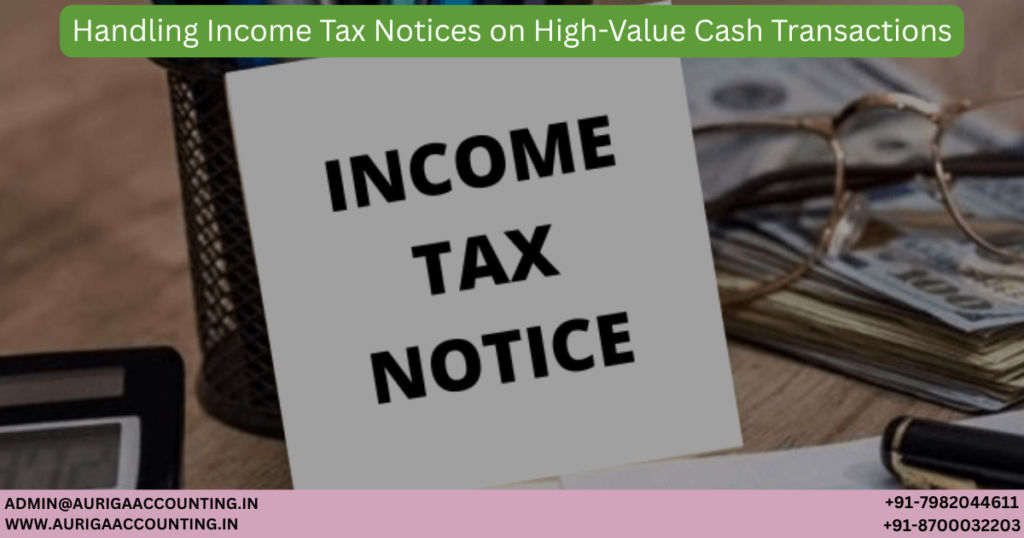
AURIGA ACCOUNTING PRIVATE LIMITED Untitled 1200 x 630 px 87

The Income Tax Department now uses advanced data analytics to identify individuals who have either not filed their income tax returns or have underreported their income. As part of its strengthened drive against tax evasion, the department has enhanced its monitoring of high-value cash transactions and adopted new methods to track them. To support this initiative, it collaborates with various government agencies to gather information on individuals who incur significant expenses but fail to file returns or accurately disclose their income.

Understanding what constitutes a high-value transaction is therefore essential. This article offers a detailed guide to understanding and responding to Income Tax Notices related to high-value cash transactions. The Auriga Accounting pvt. ltd. expert team is available to help you respond to such notices efficiently and in full compliance with tax regulations.
Latest Updates

Income Tax Alert: Notices for Transactions Exceeding ₹10 Lakh Annually

The Income Tax Department closely tracks high-value transactions in bank accounts to curb tax evasion. As per Section 269ST of the Income Tax Act, savings account holders who deposit more than ₹10 lakh in cash during a financial year (April 1 to March 31) may come under scrutiny.

Additionally, cash transactions exceeding ₹2 lakh in a single day or in related transactions on the same day are mandatorily reported to the Income Tax Department under Section 114B.

To remain compliant, ensure that:

  • Your total annual cash deposits stay within ₹10 lakh

  • You do not deposit more than ₹2 lakh in cash in a single day or related transactions

  • PAN is provided for cash deposits exceeding ₹50,000 in a day (or Form 60/61 if PAN is unavailable)

If you receive a notice for high-value transactions, maintain proper documentation such as bank statements and proof of income sources like business receipts or gifts. Ensure all transactions are correctly disclosed in your Income Tax Return (ITR) to avoid penalties and further scrutiny.

What Are High-Value Transactions?

High-value transactions involve large financial movements exceeding prescribed thresholds. The Income Tax Department monitors these transactions through Specified Financial Transactions (SFTs), which must be reported via Form 61A by designated reporting entities. This reporting mechanism enables the department to systematically track substantial financial activity throughout the financial year.

Transactions That May Trigger Income Tax Notices

The following high-value transactions may lead to scrutiny and possible issuance of income tax notices:

  • Cash deposits in fixed or recurring deposits: Deposits exceeding ₹10 lakh in a financial year

  • Cash payments for banker’s cheques, drafts, or pay orders: Payments above ₹10 lakh

  • Cash deposits or withdrawals in current accounts: Transactions exceeding ₹50 lakh annually

  • Immovable property transactions: Purchase or sale valued at ₹30 lakh or more

  • Investments in bonds, debentures, or mutual funds: Investments above ₹10 lakh

  • Credit card payments (non-cash): Exceeding ₹10 lakh in a financial year

  • Cash payments toward credit card bills: Exceeding ₹1 lakh

  • Foreign currency transactions: Spending or purchases exceeding ₹10 lakh annually under FEMA, 1999

How the Income Tax Department Tracks High-Value Transactions

The department employs multiple mechanisms to monitor financial activity:

  • Enhanced Form 26AS & AIS: Expanded to include SFT details, consolidating data from banks, registrars, post offices, and stock exchanges

  • TDS on Cash Withdrawals:

    • 2% TDS on withdrawals exceeding ₹1 crore

    • For non-filers: 2% on withdrawals above ₹20 lakh and 5% beyond ₹1 crore

  • Mandatory ITR Filing: Even individuals earning below ₹2.5 lakh must file returns if they engage in high-value transactions

Responding to SFT Transactions Reflected in Form 26AS

If SFT entries appear in Form 26AS or AIS, taxpayers should first verify their accuracy. These transactions must be correctly disclosed while filing the ITR, and the applicable tax must be computed accurately. Any mismatch or omission may result in an income tax notice.


Penalties for Non-Compliance with High-Value Transaction Reporting

Under Section 271FA of the Income Tax Act, 1961:

  • Mandatory Reporting: Entities required to report high-value transactions must comply

  • Penalty for Delay or Failure: ₹500 per day until the required statement is submitted

  • Continuous Accrual: Penalties accrue daily until compliance

  • Intent Not Considered: Even unintentional errors attract penalties

  • Objective: To ensure transparency, prevent tax evasion, and curb money laundering

Responding to Income Tax Notices on High-Value Transactions

Accurate reporting while filing ITRs is essential to avoid notices and penalties. If you receive a notice related to high-value transactions, follow these steps on the Income Tax Compliance Portal:

  1. Log in to the Portal: Use your PAN and password

  2. Review Transactions: Navigate to Pending Actions > Compliance Portal > E-Campaign

  3. Select the Relevant Campaign: Active campaigns will be displayed on the dashboard

  4. Check Expected Information: Entries marked “E” indicate information sought by the department

  5. Submit Your Response: Choose from available options such as “Information is correct” or “Information is not fully correct”

For complex matters or uncertainty in reporting income, consulting tax professionals is strongly advised. Expert assistance ensures accurate compliance and timely resolution of income tax notices.

About the Author

Dakesh

Dakesh simplifies complex legal regulations into practical, easy-to-follow guidance, enabling entrepreneurs to stay compliant while building sustainable and scalable businesses.

January 8, 2026

new

RELATED ARTICLES

Untitled (1200 x 630 px) (92)
Tax Saving Options Beyond Section 80C
Tax Saving...
Untitled (1200 x 630 px) (91)
Section 80GGA: Tax Deductions for Scientific Research Donations
Section 80GGA:...
Untitled (1200 x 630 px) (90)
Form 10IE or Form 10IEA: Which Form Is Right for You?
Form 10IE...
Untitled (1200 x 630 px) (89)
Guide to Income Tax Notices for Salaried Employees
Guide to Income...
Untitled (1200 x 630 px) (88)
How to Verify and Authenticate an Income Tax Notice Online
How to Verify...
Untitled (1200 x 630 px) (87)
Handling Income Tax Notices on High-Value Cash Transactions
Handling Income...
Untitled (1200 x 630 px) (86)
How to Respond to Income Tax Notices After Filing ITR
How to Respond...
Untitled (1200 x 630 px) (85)
Old vs New Tax Regime (2025): Which Is Better for You?
Old vs New...
Untitled (1200 x 630 px) (83)
What Are the Common Mistakes Made While Filing an ITR?
What Are the...
×