Dakesh
“Dakesh translates complex legal regulations into clear, actionable guidance, helping entrepreneurs remain compliant while growing sustainable and scalable businesses.”


Introduction
ToggleIf there’s a mismatch between the deductions or exemptions you claimed in your Income Tax Return (ITR) and the details in your Form 16 or Annual Information Statement (AIS), or if documents like rent receipts for House Rent Allowance (HRA) claims are questionable, you may receive a notice from the Income Tax Department. These communications highlight inconsistencies or errors in your ITR and can relate to issues such as missed filings, inaccuracies in reported income, mismatched tax credits, or overlooked self-assessment taxes.
Understanding the types of income tax notices and how to respond is essential for resolving them efficiently. The Auriga Accounting pvt. ltd. expert team provides support to ensure a smooth and compliant resolution process.
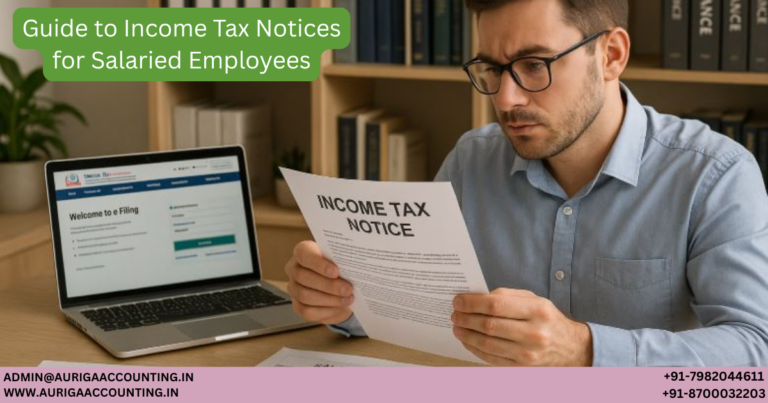
An income tax notice is an official communication from the Income Tax Department to taxpayers. Notices are issued for various reasons related to the filing, processing, or assessment of an ITR. They are part of the department’s enforcement measures to ensure accurate reporting and timely tax payments.
Receiving a notice can be alarming, even if you have filed your taxes diligently. Notices may arise due to:
Discrepancies in your tax return: Errors in reported income, personal details, or asset declarations.
Mismatched income reports: Underreported income flagged by the department requires supporting documents such as payslips, invoices, or bank statements.
Significant financial fluctuations: Large changes in income or investments may attract scrutiny.
TDS inconsistencies: Differences between reported TDS and figures in Form 26AS or 16A can trigger a notice under Section 143(1).
Audit selections: Returns may be chosen for detailed scrutiny under Section 143(2) due to reporting errors or mismatches.
Late filings: Missing the ITR deadline can result in a notice.
Refunds and outstanding liabilities: Undisclosed income may lead the department to adjust taxes against claimed refunds.
Past tax issues: Unresolved matters from previous years may result in notices under Section 147.
Receiving a notice does not automatically imply wrongdoing. Notices can be routine checks or clarifications for minor discrepancies, such as verifying income details or supporting claimed deductions.
Notice under Section 142(1): Requests additional information or clarifications, often for missed filings.
Notice under Section 139(9): Sent for a defective return; you have 15 days to correct errors.
Notice under Section 148: Issued when income is suspected to be underreported.
Notice under Section 156: A demand notice requesting payment of taxes, interest, or penalties.
Intimation under Section 143(1): Highlights discrepancies between your ITR and department calculations.
Notice under Sections 143(2) & 143(3): Detailed scrutiny and verification of your return.
Notice under Section 131: Summons for personal appearance if tax evasion is suspected.
Notice under Section 245: Adjusts outstanding dues from previous years against refunds.
To minimize the risk of notices:
Report all income accurately, including interest from savings and FDs.
Verify pre-filled ITR information against personal records.
Cross-check deductions and tax credits with supporting documents.
Document all high-value transactions properly.
Access the e-Filing Portal: Log in with your PAN and password.
Navigate to E-Proceedings: Check the ‘Pending Actions’ section to view notices.
Review the Notice: Understand the nature of the discrepancy or information requested.
Submit Your Response: Choose between a ‘full’ or ‘partial’ response.
Detail Your Response: Keep it concise and clear; character limits usually apply.
Attach Supporting Documents: Upload relevant files such as receipts, invoices, or annexures.
Confirm and E-Verify: Ensure accuracy, then e-verify using Aadhaar OTP, EVC, or digital signature.
Consult a Professional: For complex notices, expert guidance from Auriga Accounting pvt. ltd. can help resolve issues efficiently.
Dakesh
“Dakesh translates complex legal regulations into clear, actionable guidance, helping entrepreneurs remain compliant while growing sustainable and scalable businesses.”



Auriga provide expert services which can get your new business off to a flying start. We are Compliance for your business. Here you get simple and affordable online company registration and range of essential services. A world class technology – driven platform, offering end to end service from startup to well established firm.
By continuing past this page, you agree to our Terms of Service,Cookie Policy,Privacy Policy,Refund Policy and Content Policies.
© AURIGA ACCOUNTING PRIVATE LIMITED | 2021 | All Rights Reserved