

Long-Term Capital Gains Tax (LTCG) is an important component of income tax, levied on profits earned from the sale of capital assets such as real estate, shares, mutual funds, bonds, and vehicles. Assets are categorized as short-term or long-term based on their holding period, with LTCG referring to gains from assets held for a longer duration—typically more than one year. Until the Union Budget 2024, long-term capital gains on equity shares and equity mutual funds exceeding ₹1 lakh in a financial year were taxed at 10%, plus applicable surcharge and cess. However, the latest budget has revised these rates, increasing the LTCG tax on equity-linked investments while reducing it for several other asset classes.
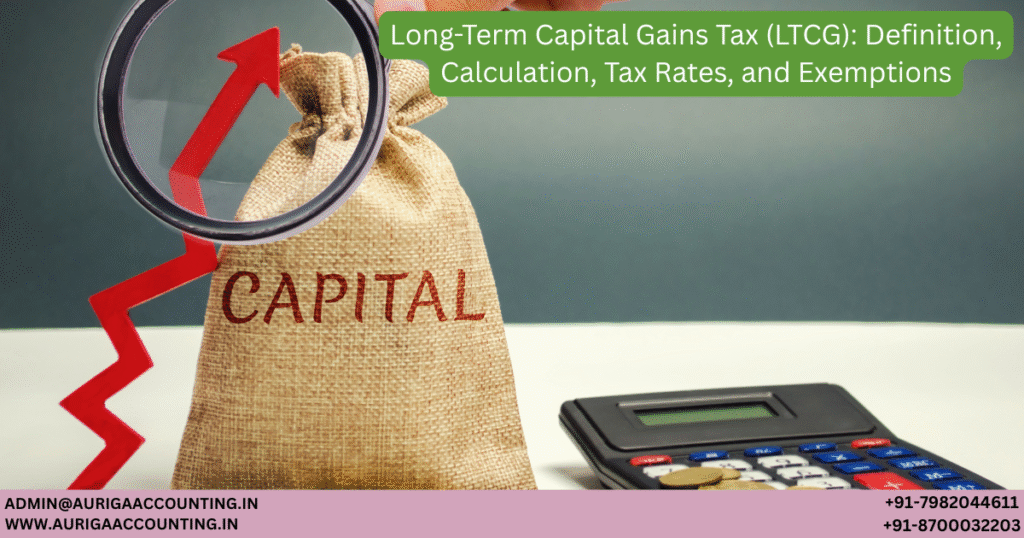
Long-Term Capital Gains Tax (LTCG): Definition, Calculation, Tax Rates, and Exemptions
Introduction
ToggleBudget 2024 Updates on Long-Term Capital Gains
The Union Budget 2024 has introduced significant changes to the long-term capital gains (LTCG) tax framework, aiming to simplify the system and offer relief to individual taxpayers. Key updates include:
1. Unified Tax Rate
All long-term capital gains—across both financial and non-financial assets—will now be taxed at a flat rate of 12.5%.
2. Higher Exemption Limit
To support lower and middle-income investors, the exemption limit on long-term capital gains from specified listed financial assets has been increased from ₹1 lakh to ₹1.25 lakh per year.
3. Updated Holding Period Criteria
Listed Financial Assets:
Gains will be considered long-term if the asset is held for more than one year.Unlisted Financial Assets & All Non-Financial Assets:
These must be held for at least two years to qualify as long-term.Unlisted Bonds & Debentures:
Capital gains from unlisted bonds, debentures, debt mutual funds, and market-linked debentures will be taxed at applicable rates regardless of the holding period.
What Are Long-Term Capital Gains (LTCG)?
Long-Term Capital Gains (LTCG) are the profits earned from selling a capital asset that has been held for a specified minimum duration—typically more than one year. Because these gains encourage long-term investing, they are generally taxed at rates lower than short-term capital gains.
The applicable LTCG tax rate depends on the type of asset, such as real estate, equities, mutual funds, or bonds. For example, equity shares and equity-oriented mutual funds often attract a 10% LTCG tax on gains exceeding a certain threshold.
Understanding how LTCG works is essential for effective tax planning and for maximizing after-tax returns, especially for investors focused on long-term wealth creation.
What Is the Long-Term Capital Gains Tax Rate (LTCG Tax Rate)?
Long-Term Capital Gains (LTCG) represent the profit earned from the sale of assets held for a specified duration. In India, the tax rate on LTCG depends on the type of asset and the date on which the transfer takes place. Below are the updated LTCG tax rates across different asset categories:
1. Listed Equity Shares & Equity-Oriented Mutual Funds
Transfers on or after 23 July 2024:
LTCG exceeding ₹1.25 lakh in a financial year is taxed at 12.5%.Transfers up to 22 July 2024:
LTCG is taxed at 10%.
2. Other Assets (Real Estate, Land, Unlisted Shares, etc.)
Transfers on or after 23 July 2024:
Except land and building: LTCG is taxed at 12.5%, without indexation benefits.
Land and building: Taxpayers may choose between:
12.5% without indexation, or
20% with indexation benefits
Transfers on or before 22 July 2024:
LTCG is taxed at 20%, with indexation benefits.
Long-Term Capital Gains Tax on Property
Long-term capital gains (LTCG) on property arise when a real estate asset—such as land or a building—is sold after being held for more than 24 months. The Union Budget 2024 has introduced revised tax rates for such gains.
Transfers made on or before 22 July 2024:
LTCG is taxed at 20% with indexation benefits.Transfers made on or after 23 July 2024:
The LTCG tax rate is 12.5%, but without indexation benefits.
To ease the transition, individuals selling land or buildings acquired before 23 July 2024 may choose between:
20% tax with indexation, or
12.5% tax without indexation
This flexibility helps taxpayers optimize their tax liability based on the asset’s acquisition cost, inflation adjustment, and expected capital gains.
Long-Term Capital Gain (LTCG) Tax on Shares
A long-term capital gain arises when shares are sold at a profit after being held for more than the prescribed holding period. The gain is calculated as the difference between the selling price and the original purchase price.
Listed Equity Shares: A holding period of at least 12 months qualifies as long-term.
Unlisted Equity Shares: A holding period of 24 months or more is required for classification as long-term.
Long-Term Capital Gain (LTCG) Tax on Mutual Funds
For equity mutual funds, units held for more than one year qualify for LTCG. The tax rules are as follows:
The first ₹1.25 lakh of LTCG in a financial year is exempt from tax.
LTCG exceeding ₹1.25 lakh is taxed at a flat rate of 12.5%.
No indexation benefit is available for equity mutual funds; tax is calculated on the full gain.
How to Calculate Long-Term Capital Gains Tax
Follow these steps to compute LTCG:
1. Determine the Full Value of Consideration
This is the total amount received on the sale of the asset, including:
Cash consideration
Fair market value of assets received
Any other non-monetary benefits
2. Calculate the Net Sale Consideration
Deduct transfer-related expenses such as:
Brokerage
Commission
Advertising or legal costs
3. Determine the Cost of Acquisition
Use the original purchase price of the asset.
For assets eligible for indexation, apply the Cost Inflation Index (CII):
Indexed Cost of Acquisition = Cost of Acquisition × (CII of year of transfer / CII of year of acquisition)
Note: Indexation benefits are not available for transfers made after July 23, 2024.
4. Deduct Applicable Exemptions
Certain LTCG may be exempt when reinvested under Sections 54, 54B, 54D, 54EC, or 54F, subject to conditions.
5. Compute LTCG Chargeable to Tax
LTCG = Net Sale Consideration – (Indexed Cost of Acquisition + Indexed Cost of Improvement) – Applicable Exemptions
Example
Sale price: ₹1,00,00,000
Transfer expenses: ₹1,00,000
Indexed cost of acquisition: ₹50,00,000
Taxable LTCG = 1,00,00,000 – 50,00,000 – 1,00,000 = ₹49,00,000
Factors Influencing Long-Term Capital Gains Calculation
Several elements impact how LTCG is computed:
1. Type of Asset
Equity-Oriented Assets: Listed shares, equity mutual funds, ELSS
Taxed at 10% on gains exceeding ₹1.25 lakh
No indexation benefit
Non-Equity Assets: Debt funds, real estate, gold
Taxed at 12.5%, with indexation allowed
Indexed cost reduces the taxable gain
2. Holding Period
Equity-oriented assets: More than 1 year
Non-equity assets: More than 3 years
Longer holding may enhance indexation benefits
3. Cost Inflation Index (CII)
Relevant for non-equity assets to adjust purchase cost for inflation
CII changes yearly based on inflation levels
4. Exemption Limits
Equity LTCG up to ₹1.25 lakh is tax-free
No exemption limit for non-equity LTCG
5. Date of Acquisition and Sale
Determines:
Holding period
Applicable CII (for non-equity assets)
Eligibility for LTCG taxation
Grandfathering Rule (for equity assets):
For shares/mutual funds purchased before 31 January 2018, the cost of acquisition is considered as the higher of:Actual purchase price
Fair Market Value as on 31 January 2018
Long-Term Capital Gains Exemptions
The Income Tax Act, 1961 provides several avenues to reduce or eliminate LTCG tax liability:
Section 54
Exemption on LTCG arising from sale of a residential property if reinvested in another residential property within the specified timeline.
Section 54EC
Exemption up to ₹50 lakh when LTCG from land or building is invested in specified bonds (e.g., NHAI, REC) within six months. These bonds must be held for the required lock-in period.
Equity Shares & Equity Mutual Funds
LTCG up to ₹1.25 lakh per financial year is exempt.
Gains above this limit attract 12.5% tax.
About the Author
Ravi
Ravi is an experienced legal writer who breaks down complex legal concepts into simple, practical insights. He helps entrepreneurs understand their legal obligations and build confident, compliant, and sustainable businesses.
April 3, 2026
new
January 10, 2026
January 8, 2026
January 8, 2026
January 8, 2026
January 8, 2026
January 8, 2026
January 7, 2026
January 7, 2026
January 7, 2026
January 7, 2026
January 7, 2026
January 7, 2026
January 7, 2026
January 6, 2026
January 6, 2026
January 2, 2026
January 2, 2026
December 31, 2025
December 31, 2025
December 31, 2025
December 29, 2025
December 29, 2025
December 29, 2025
December 29, 2025
December 29, 2025
December 27, 2025
December 27, 2025
December 27, 2025
December 26, 2025
December 26, 2025
December 26, 2025
December 16, 2025
December 16, 2025
December 15, 2025
December 13, 2025
December 13, 2025
December 12, 2025
December 12, 2025
November 29, 2025
November 29, 2025
November 29, 2025
November 28, 2025
November 28, 2025
November 28, 2025
November 28, 2025
November 27, 2025
November 27, 2025
November 27, 2025
November 27, 2025
November 27, 2025
November 27, 2025
November 26, 2025
November 26, 2025
November 26, 2025
November 26, 2025
November 25, 2025
November 25, 2025
November 25, 2025
November 25, 2025
November 24, 2025
November 24, 2025
November 24, 2025
November 24, 2025
November 24, 2025
November 21, 2025
November 21, 2025
November 21, 2025
November 21, 2025
November 20, 2025
November 20, 2025
November 20, 2025
November 20, 2025
November 20, 2025
November 20, 2025
November 20, 2025
November 19, 2025
November 19, 2025
November 19, 2025
November 17, 2025
November 17, 2025
November 15, 2025
November 15, 2025
November 15, 2025
November 13, 2025
November 13, 2025
November 13, 2025
June 16, 2025
June 16, 2025
June 14, 2025
June 14, 2025
June 13, 2025
June 13, 2025
June 11, 2025
June 11, 2025
June 11, 2025
June 10, 2025
June 9, 2025
June 9, 2025
June 5, 2025
June 5, 2025
June 5, 2025
June 5, 2025
June 5, 2025
June 5, 2025
June 5, 2025
June 5, 2025
June 4, 2025
June 4, 2025
June 4, 2025
June 3, 2025
June 3, 2025
June 3, 2025
May 31, 2025
May 31, 2025
May 31, 2025
May 31, 2025
May 31, 2025
May 30, 2025
May 30, 2025
May 30, 2025
May 30, 2025
May 29, 2025
May 29, 2025
May 29, 2025
May 29, 2025
May 28, 2025
May 28, 2025
May 28, 2025
May 28, 2025
May 27, 2025
May 27, 2025
May 27, 2025
May 27, 2025
May 27, 2025
May 26, 2025
May 26, 2025
May 26, 2025
May 26, 2025
May 26, 2025
May 24, 2025
May 24, 2025
May 24, 2025
May 24, 2025
May 24, 2025
May 23, 2025
May 23, 2025
May 23, 2025
May 23, 2025
May 23, 2025
May 23, 2025
May 23, 2025
May 23, 2025
May 22, 2025
May 22, 2025
May 22, 2025
May 22, 2025
May 21, 2025
May 21, 2025
May 21, 2025
May 21, 2025
May 21, 2025
May 20, 2025
May 17, 2025
May 17, 2025
May 17, 2025
May 17, 2025
May 16, 2025
May 16, 2025
May 16, 2025
May 15, 2025
May 15, 2025
May 15, 2025
May 14, 2025
May 13, 2025
May 13, 2025
May 13, 2025
May 13, 2025
May 13, 2025
May 12, 2025
May 12, 2025
May 12, 2025
May 12, 2025
May 10, 2025
May 10, 2025
May 10, 2025
May 10, 2025
May 9, 2025
May 9, 2025
May 9, 2025
May 9, 2025
May 9, 2025
May 8, 2025
May 8, 2025
May 8, 2025
May 8, 2025
May 8, 2025
May 8, 2025
May 8, 2025
May 7, 2025
May 7, 2025
May 7, 2025
May 7, 2025
May 7, 2025
May 7, 2025
May 6, 2025
May 5, 2025
May 5, 2025
May 5, 2025
May 3, 2025
May 3, 2025
May 3, 2025
May 3, 2025
May 3, 2025
April 30, 2025
April 30, 2025
April 29, 2025
April 28, 2025
April 28, 2025
April 28, 2025
April 28, 2025
April 26, 2025
April 26, 2025
April 26, 2025
April 26, 2025
April 26, 2025
April 25, 2025
April 25, 2025
April 24, 2025
April 23, 2025
February 1, 2024
October 30, 2023
October 30, 2023
October 30, 2023
October 30, 2023
October 28, 2023
October 28, 2023
October 28, 2023
October 28, 2023
October 28, 2023
October 28, 2023
October 28, 2023
October 28, 2023
October 28, 2023
October 27, 2023
October 27, 2023
October 27, 2023
October 27, 2023
October 27, 2023
October 27, 2023
October 27, 2023
October 27, 2023
October 26, 2023
October 26, 2023
October 26, 2023
October 26, 2023
October 26, 2023
October 23, 2023
October 23, 2023
October 23, 2023
October 23, 2023
October 23, 2023
October 23, 2023
October 23, 2023
October 23, 2023
October 23, 2023
October 23, 2023
October 23, 2023
October 23, 2023
October 23, 2023
October 23, 2023
October 23, 2023
October 21, 2023
October 21, 2023
October 21, 2023
October 21, 2023
October 21, 2023
October 21, 2023
October 21, 2023
October 21, 2023
October 21, 2023
October 21, 2023
October 21, 2023
October 21, 2023
October 21, 2023
September 7, 2023
September 7, 2023
September 6, 2023
September 6, 2023
September 5, 2023
September 5, 2023
September 5, 2023
September 5, 2023
September 4, 2023
September 4, 2023
September 4, 2023
September 4, 2023
September 1, 2023
September 1, 2023
September 1, 2023
September 1, 2023
August 30, 2023
August 30, 2023
August 30, 2023
August 29, 2023
August 29, 2023
August 29, 2023
August 29, 2023
August 28, 2023
August 28, 2023
August 28, 2023
August 28, 2023
August 28, 2023
August 26, 2023
August 26, 2023
August 26, 2023
August 26, 2023
August 25, 2023
August 25, 2023
August 25, 2023
August 25, 2023
August 24, 2023
August 24, 2023
August 24, 2023
August 24, 2023
August 22, 2023
August 22, 2023
August 22, 2023
August 22, 2023
August 22, 2023
August 21, 2023
August 21, 2023
August 21, 2023
August 21, 2023
RELATED ARTICLES

Key Reasons...
Simple Tax-Saving...

GST Compliance:...


Tax Saving...

Section 80GGA:...


Guide to Income...
No posts found
