Skip to content
Auriga accounting
Edit Content
auriga accounting
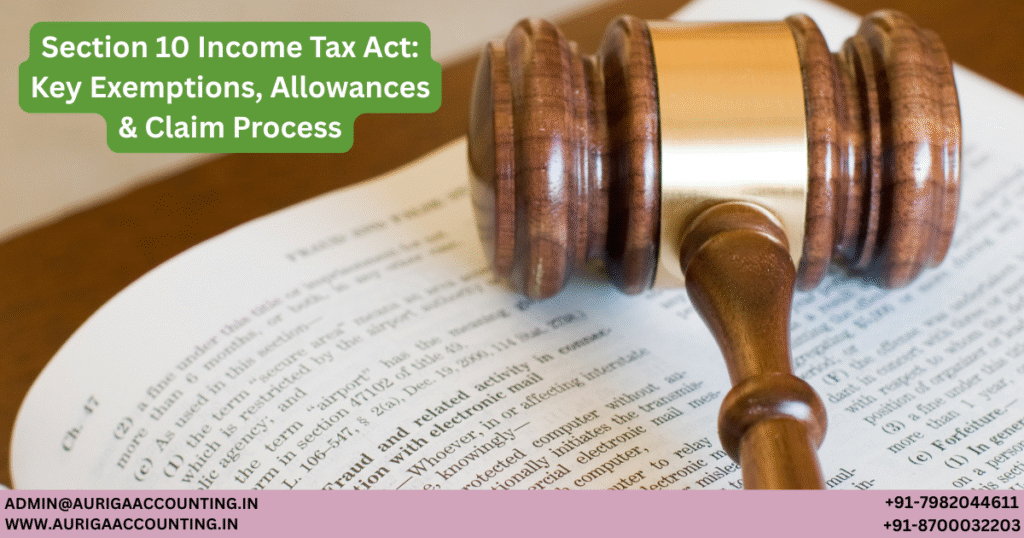
AURIGA ACCOUNTING PRIVATE LIMITED Section 10 Income Tax Act Key Exemptions Allowances Claim Process

Section 10 of the Income-tax Act, 1961, offers a range of exemptions and allowances designed to reduce the tax burden on individuals—especially salaried employees. Introduced by the Government of India, these provisions allow taxpayers to claim exemptions on various income components, including House Rent Allowance (HRA), travel allowances, gratuity, and leave encashment. The section also covers tax exemptions on maturity proceeds from certain life insurance policies, subject to specific conditions.

To avail these benefits, taxpayers must submit the necessary documents and report the relevant details in their income tax return, ensuring the income qualifies under the prescribed exempt categories. This article provides a comprehensive explanation of Section 10 and the exemptions available under it.

What Is Section 10 of the Income Tax Act?

Section 10 of the Income Tax Act lists various categories of income that are fully or partially exempt from taxation. These exemptions apply to multiple sources of income, including agricultural earnings, specific allowances for employees, certain insurance proceeds, and income received by notified institutions or funds. The primary objective of Section 10 is to offer tax relief, promote targeted economic activities, and support individuals and organisations through specific tax-free income provisions.

Exemptions Under Section 10 of the Income Tax Act

Below is a detailed overview of major exemptions available under Section 10:


Section 10(1) – Agricultural Income

Section 10(1) exempts certain categories of agricultural income, including:

  • Sale of Agricultural Produce: Income from selling crops, fruits, vegetables, or any produce grown on agricultural land.

  • Agricultural Operations: Earnings from core farming activities such as sowing, cultivation, and tilling.

  • Rent/Revenue from Agricultural Land: Rent received from agricultural land used for farming in India.

  • Farm Buildings: Income from buildings essential for agricultural operations, such as barns or storage structures.

  • Operations for Crop Growth/Preservation: Income from tasks like pruning, weeding, and other crop-maintenance activities.


Section 10(5) – Leave Travel Allowance (LTA)

Section 10(5) provides exemption on Leave Travel Allowance for domestic travel. The exemption applies only to travel expenses—airfare, railway fare, or bus fare. Costs related to accommodation, local transport, sightseeing, or meals are not exempt.

Example:
If an employee receives ₹40,000 as LTA but spends only ₹25,000 on eligible travel expenses, only ₹25,000 qualifies for exemption. The remaining ₹15,000 becomes taxable.


Section 10(10AA) – Leave Encashment

This section allows exemption on leave encashment received at the time of retirement or resignation.

  • Government employees: Entire leave encashment amount is exempt.

  • Non-government employees: Exemption is limited to the lowest of the following:

    • ₹25,00,000 (maximum limit)

    • Actual leave encashment received

    • Average salary of the last 10 months

    • Cash equivalent of unused leave at retirement

Example:
If a retired employee receives ₹5,00,000 and the cash value of unavailed leave is ₹60,000, the exemption will be ₹60,000 (the lowest value). Remaining amount is taxable.


Section 10(10D) – Life Insurance Policy Maturity Proceeds

Maturity proceeds (including bonuses) from life insurance policies are tax-exempt, subject to conditions. Exceptions include:

  • Keyman insurance policies

  • Policies with premiums exceeding the prescribed limits

  • Certain policies issued after 1 February 2021

Special exemptions apply for policies issued to individuals with disabilities or specified diseases.


Section 10(13A) – House Rent Allowance (HRA)

HRA received from an employer is exempt to the extent of actual rent paid and subject to certain conditions. No exemption is available if the employee lives in self-owned accommodation or pays no rent.


Section 10(14) – Special Allowances

This section provides exemptions for special allowances granted to employees, including:

  • Allowances for official duties

  • Allowances compensating high cost of living at particular postings

Only job-related expenses or location-based personal allowances qualify for exemption.


Section 10(23C) – Income of Charitable and Educational Institutions

Section 10(23C) exempts income received by certain government-approved funds and institutions, such as:

  • PM National Relief Fund

  • PM CARES Fund

  • Swachh Bharat Kosh

  • Clean Ganga Fund

  • Universities, educational institutions, and hospitals


Section 10(34) – Dividend Income

Dividends from Indian companies taxed under Section 115-O are exempt. However, this exemption does not apply where dividends are taxable under Section 115BBDA. For dividends received after 1 April 2020, exemption applies only if tax under both sections has already been paid.


Section 10(37) – Capital Gains on Transfer of Agricultural Land

Capital gains from the transfer of agricultural land are exempt if:

  • The land is in a specified area

  • It was used for agricultural purposes for at least two years before transfer

  • Transfer occurs through compulsory acquisition or through government-approved arrangements

  • Compensation is received on or after 1 April 2004


Section 10(26) – Income of Scheduled Tribe Members

This section provides exemption for members of Scheduled Tribes living in specified areas, including:

  • Areas in the Sixth Schedule

  • Certain northeastern states

  • Ladakh region

The exemption applies to income earned within these areas and to dividends or interest on securities.


Section 10(38) – Long-Term Capital Gains on Equity Shares

Long-term capital gains from the sale of equity shares or units of equity-oriented funds/business trusts are exempt if:

  • Securities Transaction Tax (STT) has been paid on the transaction

  • Specific conditions regarding purchase date, stock exchange location, and transaction type are fulfilled

For companies, such gains are included in book profits under Section 115JB.


Section 10(46) – Income of Specified Government-Notified Bodies

Income of certain boards, authorities, trusts, or commissions established by the government is exempt, provided:

  • They are notified by the Central Government

  • They do not engage in commercial activities

Section 10 Exemption List

Below is a comprehensive list of exemptions available under Section 10 of the Income-tax Act, along with their corresponding clauses and descriptions:


SectionDescription
Section 10(1)Exempts agricultural income derived from agricultural land in India.
Section 10(2)Exemption for amounts received by a member from the income of a Hindu Undivided Family (HUF).
Section 10(2A)Share of profit received from a partnership firm—exempt since the firm is already taxed on its income.
Section 10(4)(i)Exemption for interest earned on certain non-resident (External) accounts.
Section 10(4)(ii)Interest received by non-residents on money lent to the Government or Indian entities.
Section 10(5)Leave Travel Concession (LTC) received by employees.
Section 10(6)Income of specified foreign individuals, such as diplomats and consular staff.
Section 10(6A)Exemption for income from technical services provided by foreign nationals in India.
Section 10(6BB)Tax paid by Government or Indian concerns on behalf of non-residents or foreign companies operating aircraft.
Section 10(6C)Income from technical services rendered in or outside India by a non-resident.
Section 10(7)Allowances or perquisites granted by the Government to its employees posted abroad.
Section 10(8)Income of foreign government employees working in India under specific technical collaborations.
Section 10(9)Remuneration or pension received by individuals working with international organizations in India.
Section 10(10)Gratuity exempt, subject to prescribed limits.
Section 10(10A)Exemption on commuted pension under specific conditions.
Section 10(10AA)Leave encashment received at the time of retirement.
Section 10(10B)Retrenchment compensation received by workers.
Section 10(10C)Amounts received under a Voluntary Retirement Scheme (VRS), subject to limits.
Section 10(10D)Tax exemption on life insurance policy maturity proceeds, including bonuses (subject to conditions).
Section 10(11)Payments received from provident funds governed by the Provident Fund Act, 1925.
Section 10(12)Accumulated balance from a recognized provident fund, under specified conditions.
Section 10(13)Payments from approved superannuation funds.
Section 10(13A)House Rent Allowance (HRA) exemption.
Section 10(14)Special allowances granted to employees to meet work-related expenses.
Section 10(15)Interest on specified securities, savings certificates, and bonds.
Section 10(16)Scholarships granted for education.
Section 10(17)Income received by Members of Parliament or State Legislatures, including daily allowances.
Section 10(17A)Awards and rewards granted by the Government for public services.
Section 10(18)Pension received by individuals awarded specified gallantry awards.
Section 10(19)Family pension received by dependents of armed forces personnel killed in service.
Section 10(19A)Privy purse received by former rulers.
Section 10(20)Income of local authorities such as municipalities.
Section 10(21)Income of scientific research associations.
Section 10(22B)Income of approved news agencies.
Section 10(23A)Income of professional associations promoting trade, commerce, or industry.
Section 10(23B)Income of institutions established for charitable purposes.
Section 10(23BB)Income of certain regulatory bodies like Agricultural Marketing Boards.
Section 10(23BBA)Income of statutory bodies established for religious or charitable activities.
Section 10(23C)Income of approved funds, educational institutions, universities, and hospitals.
Section 10(24)Income of registered trade unions.
Section 10(25)Income received by trustees of recognized provident, pension, or superannuation funds.
Section 10(26)Income of Scheduled Tribe members residing in specified areas.
Section 10(26A)Income of residents of Ladakh from specified sources.
Section 10(26AAA)Income of Sikkimese individuals under prescribed conditions.
Section 10(27)Income of co-operative societies engaged in marketing agricultural produce of their members.
Section 10(30)Government subsidies received by tea growers for replantation.
Section 10(31)Subsidies received for cultivating rubber, coffee, cardamom, and other specified crops.
Section 10(32)Exemption for a minor’s income included in the parent’s taxable income (up to a specified limit).
Section 10(33)Certain dividend income from specified sources.
Section 10(34)Dividend income, except those covered under DDT-related taxable provisions.
Section 10(35)Income from units of mutual funds, UTI, or specified undertakings.
Section 10(36)Long-term capital gains on certain shares purchased between 1 March 2003 and 1 March 2004.
Section 10(37)Capital gains from compulsory acquisition of urban agricultural land.
Section 10(38)Long-term capital gains on listed equity shares or equity mutual funds (subject to updated provisions).
Section 10(39)Income from international sporting events held in India.
Section 10(40)Income of specified subsidiaries of overseas financial organizations.
Section 10(41)Capital gains from transfer of assets for shifting an industrial undertaking from urban to non-urban areas.
Section 10(42)Income of notified bodies.
Section 10(43)Amounts received under a reverse mortgage scheme.
Section 10(44)Income of the New Pension System Trust (NPS Trust).
Section 10(45)Compensation received under agreements relating to nationalization of coal mines.
Section 10(46)Income of certain notified boards, authorities, and commissions performing public functions.
Section 10(47)Income of specified infrastructure debt funds.
Section 10(48)Income received in Indian currency by foreign companies for the sale of crude oil under approved agreements.
Section 10(48A)Income of foreign companies from storage and sale of crude oil under agreements with the Central Government.
Section 10(48B)Income of foreign companies from selling leftover crude oil after expiry of strategic reserve agreements.
Section 10(49)Income of National Financial Holdings Company Limited (valid up to 1 April 2014).
Section 10(50)Income from specified e-commerce transactions subject to equalisation levy (effective from 1 April 2020).
How to Claim Exemptions Under Section 10?

Follow these steps to claim exemptions available under Section 10 of the Income-tax Act:


Step 1: Identify Applicable Exemptions

Start by determining which exemptions under Section 10 apply to your income sources—such as House Rent Allowance (HRA), Leave Travel Concession (LTC), agricultural income, or other eligible categories.


Step 2: Report Income and Declare Exemptions

While filing your Income Tax Return (ITR):

  • Report all income sources, including taxable and exempt income.

  • Disclose exempt income separately, mentioning the relevant Section 10 clause and exemption amount.


Step 3: Keep Supporting Documents Ready

Maintain proper documentation to validate your exemption claims, such as:

  • Salary slips

  • Form 16

  • Expense vouchers

  • Investment proofs

  • Employer-provided certificates


Step 4: Compute Taxable Income

Deduct all eligible Section 10 exemptions from your total income to arrive at your taxable income.


Step 5: Select the Correct ITR Form

Choose the appropriate ITR form based on your income type, employment category, and the exemptions you are claiming.


Step 6: File Accurately and On Time

Complete your ITR with accurate details and submit it before the deadline prescribed by the Income Tax Department.

Is Section 10 Applicable to All Indian Taxpayers?

No, Section 10 exemptions are not applicable to all taxpayers. The benefits under Section 10 apply only to specific types of income and particular circumstances. For example, exemptions may be available for House Rent Allowance (HRA), Leave Travel Allowance (LTA), agricultural income, or certain retirement-related payments. Whether these exemptions apply depends on factors such as your income type, employment status, and individual eligibility.

About the Author

Vinod

Vinod is an experienced legal writer who transforms complex legal concepts into clear, practical insights. His work empowers entrepreneurs to understand their legal responsibilities and build compliant, sustainable businesses with confidence.

February 1, 2026

new

RELATED ARTICLES

Untitled (1200 x 630 px) - 2026-01-10T150331
Key Reasons for Receiving an Income Tax Notice
Key Reasons...
Untitled (1200 x 630 px) (99)
Simple Tax-Saving Strategies for Salaried Employees
Simple Tax-Saving...
Untitled (1200 x 630 px) (97)
File Your Income Tax Return with Pay Later Option
File Your...
Untitled (1200 x 630 px) (96)
GST Compliance: End-of-Year Checklist
GST Compliance:...
Untitled (1200 x 630 px) (93)
Key GST & Income Tax Compliances to Complete by 31st March 2024
Key GST &...
Untitled (1200 x 630 px) (92)
Tax Saving Options Beyond Section 80C
Tax Saving...
Untitled (1200 x 630 px) (91)
Section 80GGA: Tax Deductions for Scientific Research Donations
Section 80GGA:...
Untitled (1200 x 630 px) (90)
Form 10IE or Form 10IEA: Which Form Is Right for You?
Form 10IE...
Untitled (1200 x 630 px) (89)
Guide to Income Tax Notices for Salaried Employees
Guide to Income...
×