Skip to content
Auriga accounting
Edit Content
auriga accounting
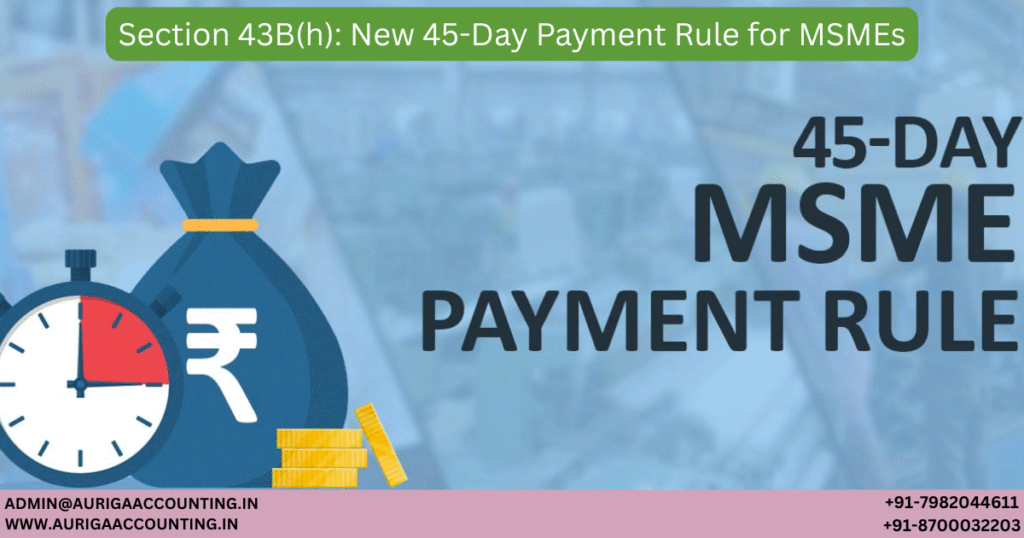
AURIGA ACCOUNTING PRIVATE LIMITED Section 43Bh New 45 Day Payment Rule for MSMEs

The Finance Act, 2023 introduced the MSME 45-day payment rule under Section 43B(h) of the Income Tax Act. Effective from April 1, 2024, and applicable from Assessment Year (AY) 2024–25 onwards, this provision requires businesses purchasing goods or services from Micro, Small, and Medium Enterprises (MSMEs) to clear payments within a specified timeframe to claim tax deductions. The rule applies to all entities dealing with MSMEs registered under the MSME Act, 2006.

In this article, we provide detailed information on the MSME 45-day payment rule, its benefits, and the consequences of failing to comply with the prescribed payment timeline.

Key Points on the MSME 45-Day Payment Rule

Below are the essential highlights of the MSME payment provisions:

Payment Deadlines & Conditions

The payment timeline depends on whether a written agreement exists between the buyer and the MSME supplier:

  • With a written agreement: Payment must be made within 45 days.

  • Without a written agreement: Payment must be made within 15 days.

If payments are not made within these timelines, the unpaid amount cannot be claimed as a tax deduction in that financial year.

Tax Implications of Late Payments

If a business fails to pay MSMEs within the prescribed deadline:

  • The expense is disallowed as a deduction for that financial year.

  • The deduction becomes allowable only in the year in which the payment is actually made.

Objective of the MSME Payment Rule

The rule aims to ensure timely payments to MSMEs, helping them maintain healthy cash flow and financial stability.

Impact on Large Businesses

Companies must adjust their payment cycles to avoid:

  • Tax disallowances

  • Cash flow disruptions

  • Additional financial burdens

Section 43B(h): New Deduction Norms for Payments to MSMEs

Section 43B(h) specifies that any amount payable to a Micro or Small Enterprise which is not paid within the time limits under Section 15 of the MSMED Act will be deductible only in the year of actual payment, irrespective of the accounting method used.
This ensures businesses comply with timely payments to MSMEs.

Applicability of Section 43B(h)

Section 43B(h) applies when:

  • A business purchases goods or services from a supplier registered under the MSMED Act, 2006.

The buyer does not need to be registered.

This provision becomes effective from April 1, 2024, meaning the benefit applies as long as the supplier is a registered micro or small enterprise.

Benefits of Clause (h) for MSMEs

1. Smooth Payment Cycle

It encourages buyers to make payments within:

  • 15 days (no written agreement)

  • 45 days (with written agreement)

This ensures MSMEs receive timely payments essential for cash flow and growth.

2. Better Bargaining Power

Since delayed payments have tax consequences for buyers, MSMEs gain stronger negotiating leverage.

3. Reduced Disputes

Timely payments reduce the likelihood of disputes, improving relationships and saving resources.


Section 43B(h) Does NOT Apply to Traders

Traders registered under Udyam for Priority Sector Lending purposes are not treated as enterprises under the MSMED Act.

Example:
If Mr. A buys goods from Mr. B (a trader), Section 43B(h) does not apply.
The provision applies only to manufacturers and service providers.

Effective Date of Section 43B(h)

The provision is effective from April 1, 2024 and applies from AY 2024-25 (FY 2023-24 onwards).

Example:
Goods purchased on March 31, 2023, are not covered.
Payments related to periods before the effective date are excluded.

Payment Time Limits Under Section 43B(h)

1. No Written Agreement

Payment must be made within 15 days from the day of acceptance.

2. With Written Agreement

Payment must be made:

  • By the due date in the agreement, OR

  • Within 45 days from the day of acceptance
    whichever is earlier.

A written objection within 15 days shifts the “day of acceptance” to the day the issue is resolved.


Tabular Summary of Timelines (Section 15, MSMED Act)

Scenario

Timeline

Details

Agreement specifies payment terms

Earlier of (a) due date in agreement or (b) 45 days from acceptance

Acceptance occurs when goods/services are delivered. Objections within 15 days shift this date.

No agreement

Within 15 days of acceptance

Same rules for objections apply.

Examples of Deduction Eligibility Under Section 43B(h)


Sr. No.Day of AcceptanceCredit PeriodDue DateActual PaymentDeduction Allowed In
910/02/20244527/03/202415/04/2024FY 2024-25
1020/08/20233019/09/202325/09/2023FY 2023-24
1105/06/20246004/08/202410/08/2024FY 2024-25
1215/07/20233014/08/202320/08/2023FY 2023-24
1322/05/20241506/06/202405/06/2024FY 2024-25
1418/03/20244502/05/202401/05/2024FY 2024-25
1528/10/20233027/11/202315/12/2023FY 2023-24
1607/12/20232027/12/202310/01/2024FY 2023-24
Penalties for Delayed Payments to MSMEs

When payments to Micro, Small, and Medium Enterprises (MSMEs) are not made within the prescribed timeline, buyers face strict consequences under the MSMED Act, 2006. The key penalties for non-compliance with the MSME 45-day payment rule are as follows:

1. Interest on Late Payment

  • Rate of Interest:
    Buyers must pay interest on delayed payments at a rate three times the RBI’s notified bank rate, compounded monthly.

2. Calculation of Interest

  • If a written agreement exists:
    Interest is charged from the due date specified in the agreement.

  • If no agreement exists:
    Interest applies from the day after the 15-day period following the date of acceptance or deemed acceptance of goods or services.

3. Interest Is Not Tax-Deductible

Under the Income Tax Act, 1961, interest paid for delayed MSME payments cannot be claimed as a tax deduction.
This provision is intended to encourage timely payments and discourage businesses from delaying their obligations to MSMEs.

Implications on the GST Component When Payments to an MSE Are Disallowed

When evaluating the tax impact of amounts payable to a Micro or Small Enterprise (MSE) that include GST, it is important to distinguish between situations where GST is claimed as Input Tax Credit (ITC) and where it is not. The treatment differs as follows:

1. GST Claimed as Input Tax Credit (ITC)

If GST is claimed as ITC, the disallowance under Section 43B(h) applies only to the base amount (excluding GST).
The GST portion is treated separately and recorded as an ITC in the books of accounts.

2. GST Not Claimed as ITC

If the purchaser does not claim GST as ITC and instead records the entire amount (including GST) as an expense in the Profit & Loss account, then:

  • The entire amount, including GST, becomes subject to the payment conditions under Section 43B(h).

  • Deductibility will depend on whether the payment—including the GST component—is made within the prescribed timelines.

Implications on the GST Component When Payments to MSMEs Are Disallowed

When evaluating the tax impact of amounts payable to a Micro or Small Enterprise (MSE/MSME) that include GST, the treatment depends on whether the GST amount is claimed as Input Tax Credit (ITC). The implications are as follows:

Summary of GST Treatment

SituationImplication on GST Component
GST Claimed as Input Tax Credit (ITC)Only the base amount (excluding GST) becomes non-deductible under Section 43B(h). The GST portion is treated separately and recorded as ITC.
GST Not Claimed as ITCThe entire amount, including GST, is subject to Section 43B(h). Deductibility depends on whether the full payment (with GST) is made within the prescribed timelines.

1. When GST Is Claimed as Input Tax Credit (ITC)

Condition:
The enterprise claims GST paid on purchases from an MSME as Input Tax Credit.

Implication:
For income tax purposes under Section 43B(h), only the base amount (exclusive of GST) is considered for deduction.

  • If this payment is delayed beyond the permitted time, only the base amount is disallowed until it is actually paid.

  • The GST portion is unaffected and continues to be recognized as ITC.

Example:
If the payable amount is ₹1,20,000 (including ₹20,000 GST) and GST is claimed as ITC:

  • Disallowance applies only to ₹1,00,000 (base amount) if payment is not made within the prescribed period.


2. When GST Is Not Claimed as Input Tax Credit

Condition:
The enterprise does not claim GST as ITC and instead records the full amount—including GST—as an expense in the Profit & Loss account.

Implication:
The entire amount, including GST, becomes subject to the timelines in Section 43B(h).

  • If payment is delayed beyond the permitted period, the entire sum is disallowed as a deduction until actually paid.

Example:
If the payable amount is ₹1,20,000 (including ₹20,000 GST) and GST is not claimed as ITC:

  • The disallowance under Section 43B(h) applies to the entire ₹1,20,000 if it is not paid within the prescribed time.

Implications of Section 43B(h) on Capital Expenditure

Section 43B of the Income Tax Act is notable for its broad applicability, covering both revenue and certain capital expenditures. The introduction of Section 43B(h) extends these principles to payments made to Micro and Small Enterprises (MSEs). Below is a clear explanation of how this provision impacts capital expenditure:

Overview of Section 43B(h)

Unlike Section 37(1), which focuses mainly on revenue expenditure, Section 43B allows deductions for specified expenses only in the year in which they are actually paid, regardless of the taxpayer’s accounting method.
Section 43B(h) follows the same principle and applies this “actual payment” rule to amounts payable to MSEs.

Scope of Section 43B(h)

Section 43B covers any sum that is otherwise deductible under the Income Tax Act.
Therefore, when a business acquires a capital asset from an MSE, the deductibility of that expenditure will follow the rules applicable to that specific capital item.

Application to Capital Expenditure

If a capital expenditure qualifies for deduction under Sections 30 to 36, then payments made to MSEs for such assets must comply with Section 43B(h).
This means the deduction is allowed only in the year of actual payment, even if the asset was acquired earlier.

Deductions for Specified Capital Expenditure

Capital expenditures eligible for full deduction—such as those covered under Section 35AD or capital investments in scientific research—also fall within the scope of Section 43B(h).
Thus, for these categories as well, the deduction is linked to the year of payment, ensuring compliance with the timelines prescribed for payments to MSEs.


5 Key Takeaways for MSMEs
  • Payment Timelines: Payments to MSMEs must be made within 15 days (if there is no written agreement) or 45 days (if a written agreement exists). Otherwise, the expense is deductible only in the year of actual payment.

  • Effective Date: The rule is effective from April 1, 2024, and applies from AY 2024–25, impacting payments made to MSMEs in FY 2023–24 onward.

  • Who It Applies To: The provision applies only to payments made to manufacturers or service providers registered under the MSMED Act, not to traders.

  • Penalties for Delays: Late payments attract interest at three times the RBI bank rate, which is not deductible under the Income Tax Act.

  • GST Treatment: If GST is claimed as ITC, only the principal amount is disallowed under Section 43B(h). If GST is not claimed as ITC, the entire amount including GST becomes disallowable.

About the Author

Ravi

  • Ravi is a skilled legal writer who breaks down complex laws into clear, practical insights. He enables entrepreneurs to understand their legal obligations, empowering them to build compliant and sustainable businesses with confidence.

     
February 17, 2026

new

RELATED ARTICLES

Untitled (1200 x 630 px) - 2026-01-10T150331
Key Reasons for Receiving an Income Tax Notice
Key Reasons...
Untitled (1200 x 630 px) (99)
Simple Tax-Saving Strategies for Salaried Employees
Simple Tax-Saving...
Untitled (1200 x 630 px) (97)
File Your Income Tax Return with Pay Later Option
File Your...
Untitled (1200 x 630 px) (96)
GST Compliance: End-of-Year Checklist
GST Compliance:...
Untitled (1200 x 630 px) (93)
Key GST & Income Tax Compliances to Complete by 31st March 2024
Key GST &...
Untitled (1200 x 630 px) (92)
Tax Saving Options Beyond Section 80C
Tax Saving...
Untitled (1200 x 630 px) (91)
Section 80GGA: Tax Deductions for Scientific Research Donations
Section 80GGA:...
Untitled (1200 x 630 px) (90)
Form 10IE or Form 10IEA: Which Form Is Right for You?
Form 10IE...
Untitled (1200 x 630 px) (89)
Guide to Income Tax Notices for Salaried Employees
Guide to Income...
×