

Skip to content
Auriga accounting
Edit Content
auriga accounting
AURIGA ACCOUNTING PRIVATE LIMITED what is minute book 2026 05 12T161401.620

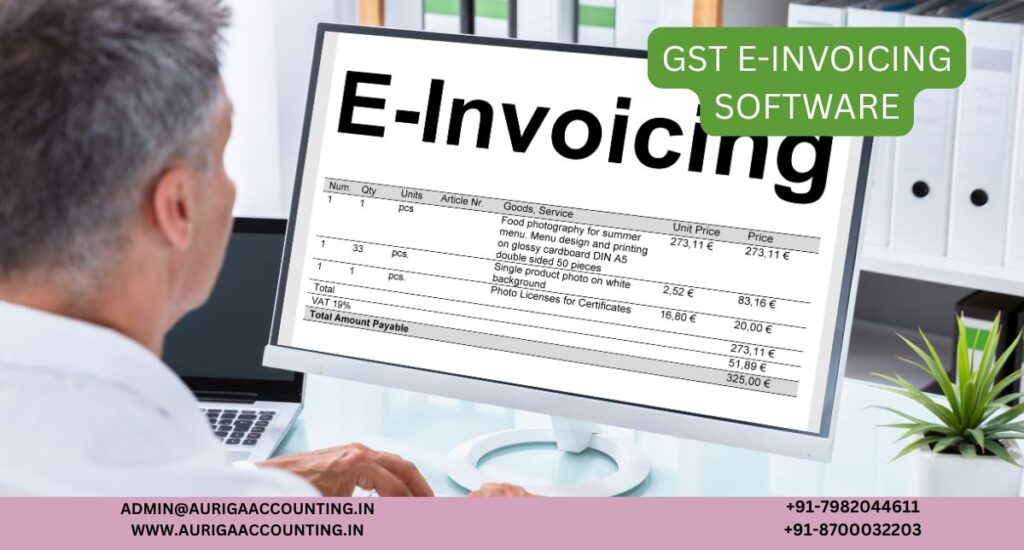
GST e-invoicing refers to the electronic generation and authentication of invoices as required under GST regulations. Just like e-way bills are mandatory for transporting goods, eligible GST-registered businesses must generate e-invoices for Business-to-Business (B2B) transactions to ensure compliance and accurate tax reporting.

As per the latest GST notification, e-invoicing has been mandatory from August 1, 2023, for all GST-registered businesses whose aggregate turnover exceeds ₹5 crores in any financial year from 2017–18 onwards.

To help businesses adapt seamlessly to this mandate, AURIGA ACCOUNTING offers LEDGERS GST e-Invoicing Software—an advanced solution designed to automate invoice generation, improve accuracy, and simplify GST compliance for growing businesses.

Key Benefits of LEDGERS GST e-Invoicing Software

  • Automated GST e-Invoice Creation
  • Real-Time IRN Generation & Validation
  • Simplified B2B Invoice Processing
  • Integrated eWay Bill Support
  • Accurate GST Compliance Management
  • Faster Billing & Reporting Workflow
  • Secure Cloud-Based Accounting System
  • End-to-End Business Automation

GST e-Invoicing System in India – Digital Invoice Authentication

The GST e-Invoicing system is a digital verification process introduced under India’s GST framework, where all Business-to-Business (B2B) invoices are electronically authenticated by the Goods and Services Tax Network. Each invoice is validated through the Invoice Registration Portal (IRP), which generates a unique Invoice Reference Number (IRN) for every approved transaction.

Once an e-invoice is created, the invoice data is automatically shared with both the GST system and eWay Bill portal in real time. This seamless integration eliminates the need for manual data entry during GSTR-1 return filing and eWay Bill generation, reducing errors and improving compliance efficiency.

Key Benefits of GST e-Invoicing

  • Electronic validation of B2B invoices by GSTN
  • Unique Invoice Reference Number (IRN) generation
  • Real-time data synchronization with GST & eWay Bill systems
  • Reduced manual data entry and filing errors
  • Faster and more accurate GSTR-1 return filing
  • Simplified compliance and reporting process
  • Improved transparency in tax administration

Benefits of GST e-Invoicing System in India

The GST e-Invoicing system was introduced to simplify GST return filing, improve accuracy in tax reporting, and enhance overall compliance efficiency for businesses. It enables real-time invoice reporting and seamless integration with the GST ecosystem.

Key Benefits of the e-Invoicing System

1. Simplified Reporting & Digital Record-Keeping
e-Invoicing enables one-time reporting of B2B invoices at the point of creation, eliminating duplicate data entry across multiple platforms. It also simplifies the maintenance of sales and purchase records, allowing easy generation of GST-compliant reports and returns.

2. Automated GST Filing & eWay Bill Generation
Invoice data is automatically shared with the GST system, helping pre-fill return forms and reducing manual effort during filing. It also enables quick and seamless generation of eWay Bills, improving logistics efficiency.

3. Better Reconciliation & Real-Time Tracking
The system reduces mismatches between accounting records and GST filings by enabling real-time invoice tracking. This improves input tax credit (ITC) verification and ensures faster and more accurate financial reconciliation.

4. Fraud Prevention & Reduced Fake Invoices
With real-time validation through the GST system, e-Invoicing helps prevent the creation of fake invoices and fraudulent transactions, strengthening transparency and compliance within the tax ecosystem.

5. Reduced Compliance Burden & Fewer Audits
Detailed transaction-level reporting reduces the likelihood of audits and inspections. This lowers administrative workload and supports better financial planning, cash flow management, and compliance control.

The GST e-Invoicing system plays a crucial role in building a more transparent, efficient, and automated tax reporting framework for businesses in India.

Businesses Eligible for GST e-Invoicing in India

GST e-Invoicing applies to GST-registered businesses that issue Business-to-Business (B2B) invoices under the Goods and Services Tax system. Eligible taxpayers must generate e-invoices for all applicable B2B transactions in compliance with GST regulations.

This system ensures standardized invoice reporting, improved accuracy, and seamless integration with the GST network for efficient tax compliance and reporting.

GST e-Invoice Applicability in India

The Government of India has progressively lowered the applicability threshold for GST e-Invoicing to expand digital compliance across businesses. As per the latest GST amendment, e-Invoicing is mandatory for all GST-registered businesses with an aggregate turnover exceeding ₹5 crore in any preceding financial year.

This rule became effective from 1st August 2023 and applies to all eligible B2B transactions, ensuring standardized invoice reporting and improved tax compliance under the GST system.

Transactions and Documents Covered Under GST e-Invoicing

Businesses that fall under the GST e-Invoicing applicability threshold must generate e-invoices for specific transactions and documents as mandated under GST rules.

Documents Covered

Under Section 34 of the CGST Act, the following documents require e-Invoicing:

  • Tax Invoices
  • Credit Notes
  • Debit Notes

Transactions Requiring GST e-Invoicing

E-Invoicing is mandatory for the following types of supplies:

  • Business-to-Business (B2B) taxable sales of goods and services
  • Business-to-Government (B2G) supplies of goods and services
  • Export and deemed export transactions
  • Supplies made to Special Economic Zones (SEZs), with or without tax payment
  • Stock transfers and service supplies between distinct persons within SEZ units
  • Transactions with SEZ developers
  • Supplies under Reverse Charge Mechanism (RCM) as per Section 9(3) of the CGST Act

Who is Exempt from GST e-Invoicing?

Although GST e-Invoicing is mandatory for many businesses, certain categories of registered persons are currently exempt from generating e-invoices under GST regulations.

Exempted Categories

1. Financial Institutions
Entities in the financial sector are exempt from e-Invoicing, including:

  • Insurance companies
  • Banking companies
  • Financial institutions
  • Non-Banking Financial Companies (NBFCs)

2. Goods Transport Agencies (GTA)
Businesses providing transportation of goods by road using goods carriage vehicles are exempt from GST e-Invoicing requirements.

3. Passenger Transport Service Providers
Companies offering passenger transportation services are not required to generate e-invoices.

4. Multiplex Cinemas
Businesses providing services related to admission for cinematograph exhibitions in multiplex screens are exempt from e-Invoicing.

5. SEZ Units
Units operating within Special Economic Zones (SEZs) are exempt from generating e-invoices. However, this exemption does not apply to SEZ developers.

GST e-Invoicing exemptions ensure that only eligible business categories are required to comply, while specific service sectors remain outside the mandate for operational convenience.

GST e-Invoice Format (INV-01) in India

The GST e-Invoice format is defined under the GST rules as Form INV-01, which provides a standardized structure for electronically recording and reporting invoice details. This format is used to submit invoice data to the Goods and Services Tax Network through the Invoice Registration Portal (IRP) in JSON format.

Structure of GST e-Invoice Format

The e-Invoice schema is divided into eight key sections:

  • Basic Details
  • Invoice Period
  • Preceding Document / Contract Reference
  • Receipt / Contract References
  • Supplier Details
  • Buyer Details
  • Payee Information
  • Delivery Information

Additional Required Information

Within these sections, businesses must also include detailed invoice data such as:

  • Item-wise invoice details
  • Document totals and tax breakdowns
  • Port codes (for exports)
  • Batch and lot details (where applicable)
  • Other transaction-specific information

Mandatory vs Optional Fields

As per GST guidelines, certain fields are mandatory for submission to the IRP, while others may be optional depending on the nature of the business and type of transaction. This structured format ensures uniformity, accuracy, and seamless digital reporting of invoices across the GST system.

Mandatory Information Required for GST e-Invoicing

To ensure compliance under GST e-Invoicing rules, businesses must include specific mandatory details while generating e-invoices. These fields help ensure accurate reporting, validation, and seamless processing through the GST system.

Key Mandatory Fields for e-Invoice

1. Supply Type Code
Indicates the nature of supply, such as:

  • B2B (Business to Business)
  • EXPWP (Export with Payment)
  • SEZWP (Supply to SEZ with Payment)

2. Document Type Code
Specifies the document category:

  • INV – Invoice
  • CRN – Credit Note
  • DBN – Debit Note

3. Document Details

  • Invoice/Document Number (as per GST rules)
  • Document Date (date of issue)

4. Supplier Details

  • Legal Name of Supplier (as per GST registration)
  • GSTIN of Supplier
  • Complete Address of Supplier
  • Location details including State Code and PIN Code

5. Buyer Details

  • Buyer’s Legal Name
  • Buyer’s GSTIN
  • Place of Supply (State Code)

6. Item-Level Information

  • Detailed list of goods/services
  • HSN/SAC codes
  • Item description, quantity, rate, and value

7. Document Totals

  • Taxable value
  • GST breakdown (CGST, SGST, IGST)
  • Discounts and final invoice total

8. Shipping Details (if applicable)

  • Ship-to name and address
  • Delivery location details (if different from buyer address)

Including these mandatory fields ensures that the e-Invoice is valid, GST-compliant, and successfully registered on the Invoice Registration Portal (IRP) through the Goods and Services Tax Network system.

Types of Documents Reported under GST e-Invoicing (IRP)

Under the GST e-Invoicing system, certain key documents must be reported to the Invoice Registration Portal (IRP) for validation and authentication through the Goods and Services Tax Network.

Documents Covered under e-Invoicing

  • Tax Invoices issued by the Supplier
  • Credit Notes issued by the Supplier
  • Debit Notes issued by the Supplier or Recipient (as applicable)

These documents are electronically verified and assigned a unique Invoice Reference Number (IRN), ensuring accuracy, transparency, and compliance within the GST framework.

About the Author

Ravi

  • Ravi is an experienced legal writer who simplifies complex laws into clear, practical guidance. He empowers entrepreneurs to understand their legal obligations so they can build compliant, sustainable businesses with confidence

May 13, 2026

new

RELATED ARTICLES

what is minute book - 2026-05-13T143133
LLP FORM 11 FILING
LLP Annual...
what is minute book - 2026-05-13T110728
FDI FILING
FDI Filing...
what is minute book - 2026-05-13T105125
EMPLOYMENT CONTRACT SOFTWARE
Best Employment...
what is minute book - 2026-05-12T163412
GST E-INVOICING & FILING SOFTWARE
LEDGERS –...
what is minute book - 2026-05-12T161401
GST E-INVOICING SOFTWARE
Best GST E-Invoicing...
what is minute book - 2026-05-12T142316
LLP ANNUAL FILING
Annual Compliance...
what is minute book - 2026-05-12T135713
COPYRIGHT REGISTRATION
Register Your...
what is minute book - 2026-05-12T121836
PATENT REGISTRATION
Patent Registration...
what is minute book - 2026-05-09T163228
WINDING UP OF A COMPANY
What is Winding...
×