Skip to content
Auriga accounting
Edit Content
auriga accounting
AURIGA ACCOUNTING PRIVATE LIMITED Untitled 1200 x 630 px 61

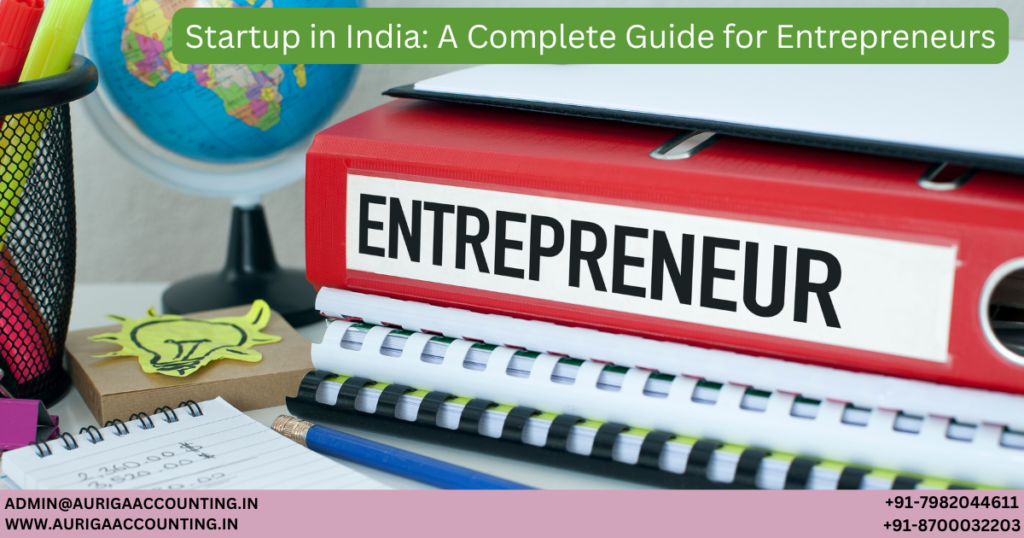
In today’s fast-paced business environment, the word startup has become synonymous with innovation, disruption, and rapid growth. But what exactly is a startup company, and how is it different from a traditional business?

A startup company is a young, innovation-driven enterprise, typically founded by one or more entrepreneurs to introduce a new product, service, or business model to the market. Unlike conventional businesses, startups prioritise speed, scalability, and experimentation, often leveraging technology and lean operations to solve problems in entirely new ways.

This guide explores everything you need to know about startups—from their defining characteristics and types to funding, challenges, and a step-by-step roadmap to launching one successfully in India.

Defining a Startup Company

While every startup is a new business, not every new business qualifies as a startup.

Key Characteristics of Startups

  • Innovation: Introduce new technologies, solutions, or business models

  • Scalability: Designed for rapid growth and large markets

  • High Risk, High Reward: Operate in uncertain environments with significant upside potential

  • Lean Structure: Small teams, limited resources, and agile decision-making

  • External Funding: Often backed by angel investors, venture capital, or crowdfunding

  • Vision-Driven: Aim to build sustainable, high-impact companies—often with acquisition or IPO goals

10 Things Every Aspiring Entrepreneur Must Know

  1. Startups Solve Real Problems – If there’s no genuine pain point, there’s no business.

  2. Innovation Is the Core – Startups are solution-first, not product-first.

  3. Speed Beats Perfection – Launch early, iterate fast with an MVP.

  4. Product–Market Fit Is Critical – Scale only after the market validates your product.

  5. Funding Helps, but Isn’t Everything – Choose funding aligned with your growth stage.

  6. Strong Teams Matter – Founders, early hires, and advisors shape success.

  7. Marketing Starts Early – Build awareness before launch.

  8. Data Drives Decisions – Metrics guide smarter growth.

  9. Failure Is Part of the Journey – Learn, adapt, and pivot quickly.

  10. Legal & Financial Compliance Is Essential – Structure, taxes, and IP protection matter.

Types of Startup Companies
  1. Lifestyle Startups – Built around personal passion and independence

  2. Small Business Startups – Local, service-based ventures

  3. Scalable Startups – High-growth, VC-backed companies

  4. Social Impact Startups – Mission-driven enterprises

  5. Large Company Startups – Innovation arms of big corporations

  6. Buyable Startups – Designed for acquisition

The Startup Lifecycle
  1. Ideation – Identify a problem and develop an MVP

  2. Validation & Launch – Test assumptions, gather feedback

  3. Growth & Scaling – Expand users, teams, and funding

  4. Maturity – Stable revenue, operational efficiency

  5. Exit or Expansion – Acquisition, IPO, or global growth

Pros and Cons of Starting a Startup

Advantages

  • Full autonomy and flexibility

  • Opportunity to pursue passion

  • High financial upside

  • Freedom to innovate

  • Meaningful customer impact

Challenges

  • High failure risk

  • Financial uncertainty

  • Intense pressure and stress

  • Competitive markets

  • Unpredictable work-life balance

How to Launch a Startup Company: Step-by-Step

1. Validate Your Idea

Research the problem, target audience, and competition. Build an MVP to test demand.

2. Create a Business Plan

Outline your vision, revenue model, market strategy, operations, and financial projections.

3. Choose the Right Legal Structure

  • Sole Proprietorship

  • Partnership

  • LLP

  • Private Limited Company (preferred for fundraising)

4. Register Under Startup India

Gain access to tax benefits, funding schemes, fast-track IP protection, and credibility.

5. Secure Funding

Explore bootstrapping, angel investors, venture capital, or crowdfunding.

6. Build the Right Team

Hire adaptable, mission-driven talent with complementary skills.

7. Build, Test, and Launch

Use agile methods, gather feedback, and improve continuously.

8. Market Your Startup

Leverage SEO, social media, content marketing, PR, and paid ads.

9. Focus on Sales & Customer Acquisition

Develop repeatable sales processes and deliver exceptional customer experience.

10. Measure, Learn, and Scale

Track KPIs like CAC, churn, revenue growth, and runway. Iterate or pivot as needed.

Startups vs Small Businesses: Key Differences


AspectStartupSmall Business
PurposeMarket disruptionServe local demand
GrowthExponentialSteady
RiskHighModerate
FundingVC/Angel-backedMostly bootstrapped
InnovationHighLimited
Common Challenges Faced by Startups
  • Achieving product–market fit

  • Managing cash flow

  • Hiring skilled talent

  • Customer acquisition

  • Competition

  • Regulatory compliance

Notable Startup Examples

Indian success stories include Zomato, Paytm, Ola, and Freshworks, while global giants like Airbnb, Uber, and Stripe began as startups solving real-world problems with scalable solutions.

Final Thoughts

A startup isn’t just a small business—it’s a high-growth venture driven by innovation, resilience, and execution. Success demands adaptability, compliance, and a deep understanding of the entrepreneurial journey.

With the right idea, team, and guidance, the Indian startup ecosystem offers limitless opportunities.

Ready to Launch Your Startup? Let Auriga Accounting pvt. ltd. Help

From company registration and Startup India certification to fundraising support, compliance, and tax management, Auriga Accounting pvt. ltd. provides end-to-end assistance to help you build and scale confidently.

Start your entrepreneurial journey with Auriga Accounting pvt. ltd. today.

About the Author

Dakesh

Dakesh simplifies complex legal regulations into clear, actionable insights, empowering entrepreneurs to remain compliant while building sustainable, scalable businesses with confidence.

May 14, 2026

new

RELATED ARTICLES

what is minute book - 2026-05-13T134811
DIN E-KYC FILING
DIR-3 KYC...
what is minute book - 2026-05-13T112841
ADT-1 FILING
Form ADT-1...
what is minute book - 2026-05-11T102653
LAWYER CONSULTATION
Online Lawyer...
what is minute book - 2026-05-08T164425
LLP WINDING UP
What is LLP...
what is minute book - 2026-05-08T115035
TRADEMARK OBJECTION
Trademark...
what is minute book - 2026-05-06T134541
MEMORANDUM OF UNDERSTANDING (MOU)
Memorandum...
what is minute book - 2026-05-06T110945
NFO
New Fund Offer...
what is minute book - 2026-05-02T163308
NEW INCOME TAX PORTAL
New Income...
what is minute book - 2026-05-02T115504
INCOME TAX SLAB
Income Tax...
×